Showing posts with label War. Show all posts

Thursday, February 09, 2012

From the Scrolls: Why Luther Still Matters


When we look back over the past five hundred years in the West, it’s easy to wonder at the battles between Catholics and Protestants that dominated the landscape. From our perch of plurality, the idea of Christians killing other Christians seems absurd. (For many of us the idea of killing over ANY religion – my story of God is better than your story of God – is more than absurd, it’s insane.) For centuries, however, especially in places like England (The battles continue in Ireland to this day), Catholics and Protestants fought a vicious, bloody battle that see-sawed through a long line of Monarchial reigns and caused the deaths of tens of thousands of innocents.

The question then, is why it still matters. What importance does Martin Luther, the figure at the heart of the Catholic/Protestant split, hold in a time where a Lutheran church and a Catholic church can be found within two blocks of one another? And what does it matter for those of us who aren’t particularly religious, except to make the point that “fighting over religion is stupid.”

Protestants, of course, lionize Martin Luther, even when he is criticized. (His anti-Semitism, for example, is often brushed aside.) But they regard him for his religious ideas, for his theology that forms the bedrock of their faith. What we miss when we discuss Luther’s revolution, however, is not only did he crack the Catholic Empire with his theology of “every man a priest,” he did so much more. The issue regarding diversity of opinion was seriously challenged for the first time. New feelings of nationhood came into effect. Our attitudes regarding work, art, and human failings all changed. We saw the first effect of mass media. And two centuries later the Protestant revolution would twin with its secular cousin in the Enlightenment and form the basis for the concept of Western Democracy.

***

So who was Martin Luther? Well, he was a miner’s son from Saxony, a devout monk and professor of theology at Wittenburg. For seven years he had wrestled with his faith, agonizing about the state of his soul in his quest for purity. When the sale of indulgences, a kind of certified check drawn by the pope on the “treasury of merit accumulated by the saints”, became a regular fundraising practice of the church, Luther was abashed and angry. (A person could buy an indulgence to lessen the term of a person, either themselves or a friend, in Purgatory.) For Luther, the whole concept of forgiveness rested on grace. This was not a trivial issue for him, but the core of the Gospel. How could true penance be bought in the open market? He was thirty-four years old when he posted his 95 theses on the door of All Saints’ church at Wittenberg, though at the time it was hardly a rebellious act. (The equivalent today would be posting a provocative article in a scholarly journal.)

What happened, however, changed the course of history. Word of his ideas spread like wildfire through Germany and beyond through pamphlets. The printing process had advanced enough to allow thousands upon thousands of Luther’s arguments to be disseminated and absorbed by the masses. Politically, Germany had been looking to break free from the papacy, and so the German princes backed Luther. What happened next, of course, is a matter of history. Later, Luther himself would persecute the early Anabaptists, who had some radical ideas of their own.

The Protestant Reformation was as much about politics as it was about theology, but in the end, it was the power of an idea that made the difference. Luther changed the common narrative. For tens of thousands living under a hierarchical and oppressive rule, particularly for the peasants, Luther’s greatest accomplishment was giving them a different story. A story that said they mattered as individuals. That God loved them despite their low station. And that they did not need to follow the dictates of corrupt, power hungry officials to be accepted by God.

When we track history, we often track individuals. Great figures that somehow stand out in their time. But usually, it isn’t the person so much as it is the idea that brings change. Martin Luther still matters because he reminds us that our struggles are often shared. That the pain we experience (in this case, it was his desire to worship devoutly and sincerely) is usually felt by those around us. And that our choice of narrative is perhaps the greatest decision we will ever make.

Who are you? What story have you chosen to live by? Are you a pawn in the masses, a person with no voice and no importance? Is your value minimal, or can you accept a new narrative that sings with your importance? Martin Luther believed that you and I were important. That we were born free, free to pursue our passions and purposes. Free to worship and live without waiting for our “betters” to tell us what to think or intercede for us. (“Every Christian is a free lord, subject to none.”) Luther believed that and changed the world. Five hundred years later he remains an important figure, not only for his accomplishments, but for the questions he asked. Questions we’d do well to answer.

-Steve

Friday, August 06, 2010

Violence Makes us Feel Better


I didn't think much of it when I stepped out onto the balcony and noticed the swarm of police cars camped out below. I'd often joked about how 911 was really unnecessary at our building because the police were usually already there. But as I looked down from my eighth floor view, I noticed entire families watching from their balconies as well. Okay, so that was new. So were the two helicopters. My stomach clenched, and decided to head downstairs. A tall, hook nosed officer at the door politely told the small group of us that no one was allowed to come or go. I waited by the elevator, willing it to come quickly. Back in my apartment, I headed out to the balcony and noticed the police tape for the first time. They'd marked off a small section of trees to the right of the front entrance. And there were more police cars. So many I lost count.


Bethany.


It was my first thought. My wife had left a couple of hours earlier to head for work, and I'd drifted off for a short nap before working out. I checked my cell phone. Breathed a sigh of relief at her text message. She was outside the city. I checked online to find out more. Apparently a woman had been thrown off a balcony on the 11th floor. The story talked about a "massage" parlour being run out of our building, her screaming, and the police kicking down the door but unable to prevent her from being thrown off the balcony.


I called my wife. Twittered. Exchanged messages. Everything heightened. Everything alive. I felt sadness, felt the barbarity of the act, but more than anything, I simply felt. What I didn't like however, was the suddenly heightened sense of importance I felt at being so near a tragedy. It was wrong, but I was too close to look at it, too close to understand what was happening. Even now, a few days later, I wish for greater sadness. Because the truth is that the most dominant feeling I experienced once I knew that my wife was safe, was excitement. Not the excitement you feel when you accomplish something or watch your team win a championship or share something with family or friends. No, it was something much darker than that.


***


Scientists have some evidence that extremely violent behavior is a result of reduced platelet serotonin levels in our brain, and that it is a dissociative disorder arising from a lack of maternal bonding and affection. What it hasn't explained is why all humans still tend towards violence. If we exempt those struggling from emotional dysfunction, (a relatively high number in our society) the better answer for the general populace when looking at violent behavior is the basic psychology behind it.


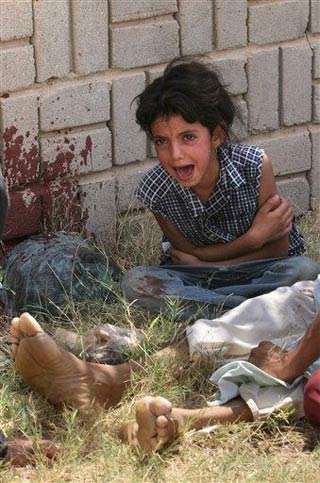
Violence makes us feel better because it raises our status, and it does so in two ways. The first is association. Being associated with violence, even as a bystander, in a liberal democratic society, immediately enhances our status, because for many of us, our daily survival is never in question. Western society has done a better job protecting its people from violence than any other in the history of civilization. We live longer than ever, and our child mortality rate is absurdly low. We may not like all that progress has brought with it, but we live in a far safer society than that of our ancestors. Violence has a darkness to it that is powerful and entrancing, and its allure is even greater when we don't have to worry about it actually affecting us. Think of the Iraq war, with hundreds of thousands of civilian Iraqi deaths, encouraged by many pundits while we simply cheered our soldiers, with no risk to ourselves, and only vague political mush to excuse our excitement over what was, and still is, happening there. When we associate with violence, we become the Roman mob, cheering the spectacle of blood at the Forum, quickened by the darkness that violence brings. It creates not only a heightened sense of awareness in our brain, but serves as a means to delineate the daily routine with an event of significance. And if the event is significant, so are we.


Violence also makes us feel better by doing. That is, we commit acts of violence against one another to preserve our status and enhance our own sense of power. That may not manifest itself in something as barbaric as throwing someone off a building, because the violence Western culture suffers is often more hidden and more subtle. Take for example, supposedly Christian forums where one believer will rip apart someone who doesn't agree with them about a minute point of Scripture. Or how whites trash blacks and heterosexuals tear apart the gay community. People wonder at the vitriol on the internet now, and argue that people would never say these things if they weren't anonymous. But that's not true. It's a different forum, to be sure, but I still remember my grandfather talking about "n******" and other races as if they were inferior. Every day I see acts of violence commited against women in both words and posturing, violence that doesn't always manifest itself physically, but does so behind closed doors more than we imagine.

And the more I read, the more I am convinced that Christopher Hitchens and Richard Dawkins do not know what they're talking about. Dawkins, in particular, has made a career out of pontificating that religion is the world's great evil. That most of the violence done throughout history was done in the name of religion. He's right, of course, excepting the Soviet experiment in the 20th Century, which was responsible for the death of about sixty million people. But doing something or committing an act in the name of religion has nothing to do with religion itself. If that were true, then atheists would be the most peaceful people on earth, and the only group who can legitimately make that claim would be the Tibetan monks.

There is a difference between verbally ripping someone to shreds and physically killing someone, but how much? What is the difference between a young person who was so emotionally abused that they will spend most of their life trying to heal, and the young person who was shot in the leg?

Whether we like it or not, the presence of violence, or even the threat of it, gives us status. This is a highly tuned evolutionary premonition, and in the eyes of many Christians, it is the prevalence of our sinful nature. And yet, it abounds. Is there anything more absurd than listening to a Christian talk about grace while mocking someone who believes differently? How is that not violent? How is that not merely a religious excuse for status grabbing? The same is true of those reject religion, and yet attack, with great vitriol, those who disagree with them, and do so with condescension and laughter. Violence has nothing to do with religion. It has its own friends and its own kind of power, and in many ways, has its own group of worshippers, a group that spans across all races, genders, and systems of belief, and it is far more dangerous.


***


I'm back on the balcony. The police tape down below is gone. They say the woman is in critical condition. They think that she will live. It is unnerving to think about what happened, or how I felt when it did. I am hoping my sadness takes hold. Mostly though, I'm thinking about a Jewish rabbi who taught odd things, when he walked around Palestine at the turn of the Century. A rabbi who taught that servanthood was better than violence. That finishing last was more important than raising your status. Even at the end, when the Romans would kill him for speaking out, his disciples did not fully grasp it, and through the centuries, his followers haven't done a great job with it either. And that includes me.


Lowering our status is not something we can do naturally. It is something we must work at, something we must ask help for in doing. We want to matter. We want to be important and have people look up at us in admiration. And unlike most civilizations, because we live longer, the task is even more difficult. Even the best of us will resort to violence because it's easy and "feels" natural. Most of us will never physically attack another person, but we will lash out verbally to remind others that they stand below us. We will mock them until they squirrel away, their self-esteem torn apart, just so they know that we're 'higher' than they are, that we're better than they will ever be. We will rape the environment without thinking about, because 'that's the way things are', and our status as humans is greater than the other living creatures with whom we share this planet.


Despite all the evidence that stands against the silly rabbi and his silly ideas, I will hold on to the hope that there's a better way. That perhaps this Jew, who spoke in a time and place of war and bloodshed, offered us something better. Better than the dark high that violence gives us, better than the feeling we get when we establish our own importance.


No one likes to feel worthless or unimportant, but perhaps we've gone about this the wrong way. Instead of spending hours on the internet establishing why we're right, what if we volunteered at a shelter instead? Or perhaps volunteered with a neighbourhood charity, as opposed to creating endless documents about why our ideas about religion or science are better than those around us. For most of recorded history, humans have used violence to increase their status. Perhaps it is time to try something else.


-Steve