Showing posts with label Movie Review. Show all posts

Monday, October 19, 2015

Tomorrowland (2015) A Review

What if all of our scientists and dreamers and writers had a chance to remake the world? And to do it without red tape or bureaucracy or any interference?

What if we had a chance to create the world of our dreams, one that not only helped the single mother but also gave license to our most inventive engineers?

This is the question that pulsates through through Tomorrowland, A Disney movie that only occasionally becomes, well, a Disney movie. (Coke, anyone?)

George Clooney plays a retired genius, a man brought to a world of dreams before he was kicked out decades earlier. He's a recluse, living in a house rigged with bombs and high-tech work to protect himself when his mates from "Tomorrowland" come to get him.

As per most movie reviews, I don't dwell on plot points. (I have always found them the most boring parts of any review, and you can find them by going to Rotten Tomatoes.)

What interests me, as both a novelist and storyteller. is what this movie attempts to do. It is grand, unexpected, and while it doesn't land it's final punch the way it could have, it is still inspiring.

When the first looks at Tomorrowland started appearing on the web in 2014, most thought it would be a box office smash. That it would be a typical box-office summer blockbuster.

That never happened.

And it's easy to see why. I'm not a huge fan of Disney (though they do have their moments) but in this movie they refuse to objectify their female teenage protagonist. (She wears a baseball hat the entire movie, a hat that belongs to her father, whom she loves.) And while there are some bitingly obvious brand placements (Coke), they do not cater to the usual "manifest destiny" of most blockbusters.

Yes, you can read it as an ode to "positivism." (Which is easily linked to individualism) But as a dreamer, you can feel more than that from the script. This isn't simply about artists. About writers. It's a movie about anyone who wants to make the world a better place. It's about people starting their own gardens. People doing ballet. People trying to do something to change the world.

Yeah, I know. It's a cliche. And if you just read this review, maybe it all sounds like a bad commercial.

It's not.

Tomorrowland takes a swing at some big ideas about humanity. No, it does not always register. It makes the typical Disney mistake of aiming too low. (Too many robots being killed that only an eight year old would like) But it tries. And in a time when Hollywood seems intent only on sequels and prequels, Tomrrowland is a bold attempt at something new.

What would tomorrow be like if we let our scientists speak? If we let our writers and artists speak? If we let everyone who had a dream for a better place not only speak, but act?

Too often, our popcorn blockbusters help us escape, but they don't make us think. Tomorrowland isn't perfect, but it does make us think. And for that, it deserves our consideration.

Highly recommended.

Steve

Sunday, August 17, 2014

Divergent (A Very, Uh, Critical Review)

Note: As I rule, I only review two types of books and movies. Ones that I really like, or ones that annoy me to such an extent that unless I'm able to vent about it in some form, it will continue to annoy me. Divergent, both the book and the movie, falls into the second category. I write fantasy, and I generally enjoy YA fantasy, but sometimes, especially when a book/series becomes popular, these things must be discussed, if only to reap some amusement from them. 


Divergent takes place in a post-apocalyptic Chicago, where the leaders have decided that humans will best survive if they are divided into five random factions. The reason for this separation is never explained, but my best guess is because other dystopian YA fantasies have factions (the Hunger Games use numbers) so that clearly whenever a nuclear war comes, humans must divide that way. And using geography was already stolen. (Damn that Suzanne Collins) The five groups are: Abnegation for the Amish selfless, Amity for the peaceful, Candor for the honest, Dauntless for the cool, pretty kids brave, and Erudite for the evil nerds smart people. Each year, all sixteen-year-olds take a test to determine which faction they will belong to for the rest of their lives.

WARNING, SPOILER ALERT!

When Tris takes the test, however, she somehow tests positively for three of the randomly divided factions. What?! How is that possible?! The examiner gravely warns her not to divulge this great secret. She is (drum roll) DIVERGENT! (Audience gasps. Murmurs. Someone from the audience yells "Say it isn't so, Tris!" His sobs continue long after the movie flickers back to life.)

Tris is fearful and scared -- and what 16 year old wouldn't be frightened by such dire results -- but she is determined to pick the one that best suits her. And by God, she will! Her parents' faction, Abegnation, means that she dresses in drab, shapeless clothing and is only allowed to look at a mirror for fifteen seconds or something because that would be vanity. (No one cares if you have stuff in your teeth! Stop being so damn selfish!) Her parents expect her to follow in their footsteps, because what kid wouldn't want that life, and yet, Tris is torn, because part of her wants to join Dauntless.

And the kids in Dauntless -- everyone in Dauntless is under thirty -- are just SO brave. They jump off moving trains and run through the town screaming like they've just come out of an Avicii concert and are looking for their next rave. They wear cool leathers and weapons and stuff, and they are like, totally free. No one else in the society gets to jump off trains and buildings and oh, did I mention how cool they are?


Friday, August 08, 2014

Top 7 Sports Movies of All-Time

If you’re going to post a “Top” movie list, there has to be some explanation behind the choices because every list like this is subjective. For me, a great sports movie taps into the mythology of both the sport and the culture it’s based on. I expect a Great Sports Movie to:

a) Still register culturally

b) Isn't so acutely interested in inspiring that they’re playing the “inspire music” after twenty minutes

c) Actually showcase a sport at the center of a film

d) Bring me to (honest) tears or make me laugh or both

e) Push me to go play that sport, or work on something I'm passionate about.

f) It MUST be a Vacation Spot, a place you can go back and watch and be all inspired again.

In keeping with the theme of this website, here are my other guidelines in choosing my Top Seven.

Guideline #1: Recency bias. I’m 42, which means some of the sports films were shot before I was born. (The Pride of the Yankees, Brian’s Song) That doesn’t necessarily preclude them from making the list, but I was less apt to include them.

Guideline #2: The avoidance of overly treacly or saccharine sports movies that seemed too interested in getting me to cry. Hey, I’m watching a sports movie. I want to be a) entertained and b) genuinely inspired. If I want to cry for the sake of crying, I can watch one of those Tom Hanks movies from the nineties or put on the news or chop some onions.

Guideline #3: No documentaries. Hoop Dreams is an extraordinary documentary, but it doesn’t make the list. A movie based on a true story is acceptable, but I’m only interested in fiction. No video memoirs.

Guideline #4: The Raging Bull Rule. Every list you see of top sports movies includes Raging Bull, which makes sense. It’s probably one of our greatest film director’s best movies, perhaps his best (Scorsese), De Niro is amazing, and it’s a boxing movie. However, nobody watches Raging Bull twice.

(Okay, nobody with an ‘F,’ in their Myers-Briggs personality test watches it twice. If you’re a ‘T,’ you process your entertainment intellectually, which means you can appreciate the technical genius of the film. If you’re not sure what I’m talking about, go to this site and take the test. It’s enlightening.)

So then, three things. Raging Bull is a brilliant and disturbing film. Raging Bull is the story of Jake LaMotta, who was an abusive, arrogant piece of human dirt and since the movie is working from his autobiography, understates just how terrible a human he was. Raging Bull is depressing as hell. So no, it didn’t make my list. Raging Bull does not inspire a Kind Life. (The literary equivalent would be Fall On Your Knees by Ann-Marie McDonald, a wonderful novel that will cause you take to take a ballpeen hammer to head… and never, ever read it again even as you recommend it to others.)

So you got all that? Okay, on to the ‘close but no cigar’ list.

FILMS THAT DIDN'T MAKE THE CUT

(What? You didn’t think I’d just drop the list on you, did you? Just scroll down if you’re impatient.)

Here are a list of the contenders, names that I’ve seen on other lists, that didn’t make the list.

A League of Their Own – My Favourite Geena Davis role of all time. Tom Hanks, brilliant. Not one you want to re-watch though, and while it entertains you, there’s no inspiration here.

Remember the Titans – Too much self-awareness. It knows that it is a VERY IMPORTANT film and never lets you forget. That self-awareness means the ending didn’t do much for me. I was aware that I was watching a CULTURAL MOMENT, and Denzel, who we all love, wasn’t allowed to “full” Denzel because, well, it was a Disney movie.

Caddyshack – This isn’t a sports movie. Stop putting on your list people. And oh yeah, GO GOPHER!

Million Dollar Baby – Wow. This movie was so good, right until the ending. Doesn’t make it due to the Ragin Bull rule. (Man, Eastwood may be a laugh on the set, but his movies are such downers. Dude needs to lighten up. Come with this website.)

Jerry Maguire –All-time sham that Cruise didn’t win an Academy award this role. I almost put this one on the list. It has the climactic moment, Renee Zellwegger when you could still recognize her, lots of humour, and is pretty re-watchable. However, “you complete me” and everything about the end of this film lets us know that it’s a romance in disguise. Nothing wrong with that, but not good for this list.

Chariots of Fire – Wonderful story, brilliant score by Vandelis, well-acted, but just a bit too precious for me.

Breaking Away – From what I hear, it’s a great movie. I’ve never seen it, so it doesn’t make the list.

42 – I loved this film. Let’s wait a few years and see how it sticks.

The Natural – If they’d followed the book (a fantastic novel by Pulitzer Prize winner Bernard Malamud) Redford would have struck out in his last at-bat, so that great scene, with the lights exploding and cascading down like fireworks, never would have happened and I would have had to leave it off the list based on the Raging Bull Rule. As it is, if I extended this list to a Top 10, The Natural makes it. Therei isn't anything that isn't great about The Natural, and any sports movie with Wilford Brimley being Wilford Brimley deserves its accolades.

Tin Cup – Hardest to leave off the list. Kevin Costner doing a sports movie is always a Good Thing, and he’s even better when he plays quirky characters. This movie is eminently re-watchable, hilarious, and that last moment when the ball finally crosses the pond and sticks is an all-time killer.


(For those of you who scrolled down to see the Top 7, before you start yelling at me because a certain movie didn’t make the cut, scroll back up and read why. Or, just throw your vitriol in the comments below.)

7. Cinderella Man – Boxing and baseball are two of the most cinematic sports (along with golf) and the ones we have most deeply mythologized over the past century. And Cinderella Man fits that narrative as the anti-Raging Bull. Based on a true story, James J. Braddock was a fighter on the verge who ended up in the poor houses before rising one more time to become champion. Russell Crowe’s Braddock is a man with a good heart, a man who just wants to support his wife and kids as the Depression sweeps across the country. After so many anti-heroes, I appreciate a film that has a humble athlete, a good person, which by all accounts, Braddock was. Zellwegger and Crowe are both terrific here, the boxing scenes are convincing, and by the time the end credits roll, you feel a bit lighter than you did before the film started. Great "Sports Movie." 

6. Field of Dreams – “Hey… Dad? Wanna have a catch?” is one of the all-time tear jerker scenes in great sports movies. And as much as Field of Dreams is a baseball fairy tale, thanks to the grounded work by Kevin Costner (sorry, he’s fantastic as an Everyman), and Amy Madigan, the film keeps it feet firmly on the ground even as it reaches for the stars. Beautiful, and in this rare case, better than the book. (Shoeless Joe by W.P. Kinsella)

5. Rudy – The quintessential inspirational sports film about a “five foot nothin’, a hundred and nothin’” Daniel “Rudy” Ruettiger, who managed to earn a place on the legendary Notre Dame football practice squad and then the field for a single game his senior year in the mid-seventies. There are reasons why people don’t like this movie. One, it has a touch of narcissism to it, Rudy’s single-minded individualism can be annoying from a certain perspective. Two, it’s been hacked to pieces by a number of satirical skits and movies. Three, it can be cloyingly “American Dream-ish,” and if you’re Canadian, like me (where we tear down our heroes) it can rub you the wrong way.

HOWEVER, I’m a dreamer. (I’m a writer, we’re all dreamers.) I challenge you to watch it again. Listen to the people telling Rudy he’s an idiot for following his dreams, listen to how they’re really trying to help him. Sound familiar? Us dreamers hear that all the time. But the movie doesn’t hate his father or anyone else who tells him he’s being foolish any more than our parents tell us we need job security. Watch the performance by Charles S. Dutton, and how his cynicism has honed into wisdom, and yet, his character still leaves room for being inspired. Sean Astin plays Rudy as being so earnest as to be on the edge of annoying, but the “want” is there in such a big way, it’s impossible not to cheer for him.

There was a time in my life when things were going nowhere. I was a struggling writer (well, that part is still somewhat true), just divorced, with only a handful of dreams and unwilling to give them up for a “practical” career that I hated. Back then, Rudy was my Vacation Spot. This is the movie I turned to, so if seems like I’m biased, well, of course I am.

The greatest scene in this movie isn’t the climactic moment when the players give up their jerseys or when he rushes onto the field or when he sacks the Georgia Tech quarterback. The greatest moment is when Rudy opens the acceptance letter down by the river and sobs softly to himself when he realizes that he’s been admitted into Notre Dame. That is a gut punch for me every time, because that’s EXACTLY the right emotional response. For something that important, you don't whoop it up. It's relief and joy and exhaustion, all rolled into one. They don’t drag the scene out, either. It’s masterfully acted and filmed, and twenty years after its initial release, the movie remains a hammer.

4. Rocky – Before Stallone became a caricature of himself, the dude could really write, and he could really act. (Or play himself, but whatever) I wasn’t aware that Rocky was based on a true story the first few times I watched it, but it doesn’t matter. The end result is a boxing film that plays on the mythology of the underdog, and instead of offering us treacly nonsense, gives us complicated relationships, very few cardboard characters (Paulie, anyone?), and a very plain Talia Shire.(Who was truly beautiful.)

The film was shot on a budget of $25,000 (Yeah, I’m looking at you, Transformer Blockbuster Toy Movie Garbage) and if you watch it enough, Stallone never looks like he’s close to getting hit in the ring. But between the great theme music, the slow, building pace, and the kick that offers not a “Championship,” but an “I Earned Respect” moment, Rocky still wins thirty years later. Awesome.

3. Major League – The funniest mainstream sports movie of all-time. Period. Major League, featuring a young (and still normal) Charlie Sheen, an in his prime Tom Berenger, Wesley Snipes in his best role, Rene Russo being, well, Rene Russo and giving the movie some heft in what could have been a throwaway role, and of course, the late, great James Gammon as Lou Brown.

I can watch this three or four times a year, and feel great every time. It might seem odd to place a straight comedy so high on the list, but name another that’s had this kind of staying power. (And no, Caddyshack is no longer funny. Why do people like that movie so much?) If you haven’t seen this one in a while and want to spend a couple of hours smiling, watch it again.

2. Bull Durham – Kevin Costner in his best role. Susan Sarandon not being too annoying. Tim Robbins the perfectly clueless and un-self-aware Kid with the Big Arm. And the writing, did I mention the writing? Ron Shelton, the screenwriter, played in the minor leagues, and he gets all the small touches right here. (Listen to the PA announcer in the background. Perfect.) And if you grew up playing the game, there’s nothing better than a sports movie that gets the damn sport right.

There are moments where you wish they’d focus less on Annie Savoy, but for her part, Sarandon gives what’s really a “groupie” character an almost regal bearing. In her world, in her town, she is not just another horny older woman going after young athletes, she’s a queen, respected by both the players and managers. (That probably would never happen in real life, but she pulls it off so succinctly that we buy it. And her.)

I memorized Crash Davis’ speech in high school, the one when he tells Annie what he believes. (I can still recite it), but for my money the best scene in the movie is the "cocksucker" scene, the one where Crash gets thrown out of the game. (It’s here, and it’s brilliant and hilarious.) There’s a soulfulness to this movie that, to me, is unique to baseball and the solitary challenge it represents within a team sport. It’s the best baseball movie ever made, and for my money, the second best Sports Movie of all-time.

AND THE NUMBER ONE SPORTS MOVIE IS...


#1. Hoosiers – No other sports movie captures the American mythology of sport and life quite like Hoosiers. No other sports movie hits every single underdog cliché like Hoosiers. And no other movie character or Indiana basketball legend ever inspired a legion of suburban white kids playing an urban sport to pick up a ball and shoot hoops like Jimmy Chitwood. (Uh, wait) And yet, AND YET, the movie never hits a false note. Never. It’s remarkable and such an achievement that when I watched the film again last year, I was shocked how well it still plays.

The key to the film, which is loosely based on the Milan high school basketball team that won the State championship before Indiana separated schools according to size, is Gene Hackman’s performance. He’s riveting here, grinding out a second chance to coach in a place like Hickory. We learn about his past, but by the time we realize why he’s coaching in a backwoods town like Hickory, we don’t care.

Some people might suggest that the romance between Norman Dale and Myra Fleener (Barbara Hershey) is played too quickly. But think back to those times. Was it? I don’t think so, and I liked the way they kept the team and the sport in the forefront. This isn’t a romantic sports drama. This is a Sports Movie.

As for the basketball, what’s not to like. As a coach, I still use some of Hackman’s well-worn truisms (“Five men functioning as one single unit, no one player greater than another”) with my teams. I use them because I believe in them. Just as Hackman’s character believed in them, just as he believed in his boys.

Feel like being inspired? Get a copy of Hoosiers, watch the Greatest Sports Movie of All-Time, and see if you don’t still believe. 
  
-Steve

NOTE: Disagree? Did I miss one? Throw it in the comments!


Monday, August 04, 2014

42 (Movie Review)


The sun blistered down from the afternoon sky. Sweat rolled down my forehead as I adjusted my cap, my feet spread and balanced beneath me. The trapper was heavier than the catcher’s mitt I usually wore, but I was only in Grade 8, my first year in a league that included high school seniors. First base was the only position available, and like any good coach’s son, I played where I was needed. It didn’t make me any less nervous. I’d be catching throws from our seventeen year old shortstop, Tim, who had a cannon for an arm. Just breathe, I told myself. You can do this. For the first three innings, I caught every throw on the grounders, and while I tried to make each play look casual – I just had to catch the ball, something I’d done since I was five – I still hadn’t relaxed.
With two outs in the fourth inning, one of the opposing team’s older players hit a rocket headed to right field. I dove to my left, and to my utter surprise, I caught it. I stared at my glove even as my teammates cheered and patted me on the back, the older players nodding in approval. I was still looking at my glove when I got to the bench.

Mr. Lesco, one of my coaches, smiled. “Nice catch, Steve. But remember, Mattingly doesn’t look at the glove.”

I nodded. I understood what he was saying. You belong here, now act like it. Don't look at your glove. I felt my shoulders loosen, and when my teammate stepped to the plate, I joined in with the other boys, excited, but no longer nervous. It was just baseball, a sport I’d played and followed since I was a child. It was a different league, but the game was the same.


Willie Mays

I remember the first time I saw Willie Mays play. I was ten years old, and the grainy, black and white footage of his famous over the shoulder catch against Cleveland in the 1954 World Series enraptured me. As a kid, I’d been regaled by tales from my father of those glory days of baseball, back when he was a young man and the world was changing. Changing so much that even he didn’t realize it. Didn’t realize what it would mean for his son. For most of my childhood, I pressed my dad for stories and read whatever I could get my hands on. Stories of the Yankees and Brooklyn Dodgers and New York Giants. Willie Mays played his last professional game when I was a baby, but well into high school, he remained my favourite player. A black man, idolized by a white boy, twenty years after he retired.

This would have been impossible when my dad was a kid. Or nearly so. When Mays broke into the major leagues as a rookie in 1951, it’d only been four years since Jackie Robinson had obliterated the colour barrier, a wall so thick it had seemed impregnable only a year earlier. Blacks playing with whites. A black athlete competing with the best Caucasian players in the world. Jesse Owens had shown a prejudiced world in 1936 what a black athlete could do, but where I came from, baseball was more important than the Olympics. Baseball was every day. Baseball was oatmeal for breakfast, girls learning to be ladies and Father Knows Best. Baseball got it right.

Before Susan Sarandon ever uttered her belief in the “church of baseball,” I believed in it, too. As a boy, the first stories I ever wrote were of Ted Williams and Mickey Mantle and of course, the, ‘Say Hey’ Kid. In my stories, I turned them into heroes off the field, saving innocent people from fires and hunting down criminals. I basked in the warm glow of sports mythology, none of which shone quite as brightly as my favourite sport. Books like Roger Kahn’s classic, The Boys of Summer, only fed my appetite for tales of the Great Ones.

When I was seventeen, my dad and I went with Mr. Lesco and his son, Josh (my best friend) to see Field of Dreams. When the movie was over, my old coach leaned over and asked me what mistake they’d made in the film. I answered without hesitation. Shoeless Joe Jackson was left handed. In the movie, Ray Liotta had played him as a righty both in the field and at the plate. He’d smiled, nodding in approval. A seventeen year old shouldn't have known those kinds of things about baseball, not about a player who’d played his last game around the end of World War I. From the time I was ten, however, something about the game made me want to be better. I didn't know it then, but baseball was, and had always been, the perfect vehicle of change for a culture redefining itself. That it was mythical didn’t make it untrue. It just meant that it had room for heroes. And when it came to heroes, no one was bigger than Jackie Robinson.


42

Fifty seven years have passed since his first game with Brooklyn, and his story now casts such a large shadow that in some ways it obliterates just how special he was, how much he endured, and how he not only saved the game itself, but forced the culture around it to shift. Shifts that still reverberate decades later. For an artist to interpret that type of story, one as powerful and mythic as Robinson’s, it requires a uniquely steady and sensitive hand. One that can fashion drama around a story that has been told and re-told, without removing the inspiration of the story itself. That is a daunting task for any film maker, and if you read the critic’s reviews of “42” when it appeared in theatres a year ago, many of them suggested that the film was “earnest and inspirational,” but “too safe and old-fashioned.”

Nonsense. In time, 42 will enter the cannon of films that extend the mythos of sports stories beyond the box score, the ones that highlight the search for human dignity and the fight for something more, a fight reflected in every civilization throughout history. The only thing “old-fashioned” about the film is that it presents the ruthlessness of racism while pushing us towards something better. It allows us to confront our demons without causing us to cover our eyes. It pushes us away, then pulls us back and asks us what we truly believe.

There are times the film underplays the abuse Robinson suffered, aside from one scene with a particularly loathsome Philadelphia manager, but director Brian Helgeland keeps the lens centered on a racist culture, if only in the background. (The seeming ubiquity of a bathroom door with ‘Whites’ on it is particularly galling. And to think this was only fifty years ago.) And too often for my liking, the movie tilts towards “The Help” territory, powerful whites helping blacks. Harrison Ford gives an inspiring, growly impression as Branch Rickey, the Dodger owner who made it his legacy to integrate the game, and his performance includes moments of genuine humour. (“Robinson’s a Methodist. I’m a Methodist. God’s a Methodist.”) Unfortunately, there are times when the movie feels it’s as much about Rickey as it is Robinson.

Those are minor criticisms. Boseman is excellent here, and as so much of the film is about the players and culture responding to him, he is less the driving force of the movie and more the anchor. He gives Robinson a steady stoicism and athletic grace on the field. Off the field, however, he allows us to see Jackie’s inner joy with his wife, and his smile lights up the screen with warmth and charisma. Helgeland, who also wrote the film and is white, writes with purpose and sensitivity. He reveals that much of our bigotry, by seemingly decent people, stems from never having to confront how we feel about certain aspects of our culture. That sometimes change occurs only when we are faced with extreme views of those beliefs.

We are all raised to believe certain things. We believe them because of our parents, our church, our teachers and coaches and everyone else who aided in our shaping. And too often, we move through our adult life without ever questioning those beliefs, those beginnings, even when they’re clearly wrong.

Here, the non-racist players are forced to confront how they really feel by their more adamantly bigoted teammates, the ones who circle a petition to have Robinson booted from the team. When the Philadelphia manager (played here with alarming force by Helgeland alum, Alan Tudyk) starts in on Robinson, the camera pans to the dugout, where some of the players, the ones who signed the petition, recoil in disgust. This is the moment they decide. Are black people human? Are they equal? Most people think we get a lifetime to make those choices, but we don’t. Life is a fast flowing river, and once we make a decision like that, we’re more apt to justify it than challenge it again.

PeeWee Reese, the Hall of Fame shortstop, helps the fans of Cincinnati hollering at Robinson come to that place by placing his arm around his new teammate at the beginning of a game. When he slaps Robinson on the shoulder and says “maybe one day, we’ll all wear your jersey,” my eyes welled up. The line is a Helgeland addition that works like one of Spike Lee’s signature visuals, pulling us briefly from the story. (It’s a nod to baseball’s new yearly tradition to choose one game in April where every player in both leagues wears Robinson’s number.)

Pulling a moviegoer out of a story is dangerous, and it must be done surgically to work properly. But even as that line slammed me back into the present, I quivered under a wave of inspiration.

We do so many damn things wrong as humans, we screw up so many times that sometimes it’s all you can do to pull your blanket over your head at our race’s incessant cruelty and ignorance. And then there are these other moments, the ones that whisper to our ability to be better, to stand beside our black teammate in the face of a white crowd, a racist white culture, and say “the hell with it. I can be better. We can be better.”

More, it’s people like Robinson, (who some will insist I am canonizing here, which I will not apologize for) who, simply by being willing to stand up for themselves in the face of great adversity, and yes, great evil, remind us that human dignity is not something cheap. That it can’t be bought or plagiarized by the next generation. That it is something we must never lose sight of, if only because of our very human tendency to exclude those who are different from us, those with whom we are unfamiliar.

The movie deals delicately with these ideas, grounding them in the players’ slow adjustment to Robinson. Bit by bit, some of them begin to see what they truly believed, begin to see the inhumanity of it and what they’ll believe in the future.

When Robinson accepts his owner’s challenge to “be tough enough not to fight back”, we’re shown how his frustration occasionally boils over, but it is only because of what he must endure. We never get the idea that Number 42 is out of place in the white league. That he feels he doesn’t belong. And by the time he hits the home run against the Pirates and glides along the bases in slow motion, we realize that he’s right. It was never about him. We didn’t know it until he showed us, but all this time it was us. We were the ones looking at our glove.

***** Highly recommended.

-Steve

NOTE: This blog is dedicated to my amazing father, Don Burns, who coached (and acted as commissioner) for Welland Minor Baseball for 35 years (and who coached me most of my life). I still remember the time he used to spend on the phone calling players and planning his practices. Our basement was inevitably crowded with baseball equipment, and to this day, I still love that smell. 

I'd also like to dedicate this to Mr. (Don) Lesco, my former coach and high school English teacher who was beloved by his players (including me)and inspired students for generations. 

And for all of you who take the time to volunteer as coaches, I want to say 'thank you,' the world is a kinder place because of you. The kids may not understand now the sacrifices that you make for them, but they will, and they'll never forget it.    


My dad and I celebrating his 72nd birthday.


Monday, October 11, 2010

Movie Review: Iron Man 2 (2010)


Directed by Jon Favreau


Have you ever wondered why sequels, especially blockbuster superhero sequels, are rarely on the same level as their predecessor? How does a stirring and enjoyable event movie get turned into a forgettable mess of discombobulated scenes and seemingly unconnected storylines. Well, sequels, as a rule, are inevitably weaker than the original that spawned them for one reason, with the exception being The Godfather and Superman: The Movie. For the purpose of this review however, let's stick to a film made more recently, and the best superhero sequel (outside the Dark Knight*) since Superman II was released in 1980.

When Spiderman hit the theatres in May of 2002, it was undisputed smash, eventually grossing over $800 million worldwide. After 25 years of being stuck in development, Sam Raimi's "origin" story was finally birthed on the big screen. Raimi immediately set out to direct the sequel, and after combing through scripts from various writers, including Pulitzer Prize winning author Michael Chabon, decided on a criminal, Doctor Octopus, a visually intriguing antagonist with a compelling backstory, and a protagonist, in this case Peter Parker, wrestling with the same demons of responsibility that Superman II had so successfully explored 25 years earlier. In doing so, Raimi was able to avoid the predominant pitfall of superhero sequels, and Spiderman II was both a commercial and critical success. Spiderman III, of course, forgot its own franchise lesson, and was not able to sustain the momentum. It was a commercial success, but not nearly as successful as its predecessors and was largely a forgettable film.

When Marvel Studios released Iron Man as its first, self-financed film in 2008, it was an unqualified (and surprise) smash with both critics and audiences everywhere. Jon Favreau directed the movie as "a spy film", and the result was another well told "origin" story, with Robert Downey Jr. cast perfectly as the inventor and gunmaker playboy Tony Stark, who builds a suit and turns himself into a superhero. Downey's Stark was crass and bold, unlike so many of the superheroes we see onscreen, and his chopped, biting dialogue a distinct turn from the bland, clichéd mouthings we were so used to hearing from the ones in tights. The story was concise and well told, the villain identifiable, and the transformation arc of the title character unforced and viable. Still, sequels were never as good as the original, and so I wasn't sure what to expect from Iron Man 2.

Unfortunately, the film falls into the most common of superhero progressions, and fails to humanize its protagonist. The result is predictable. Weak, disjointed storylines. No common theme. Inhuman and unrelatable villains. A lot of bang, but not a lot of buck. And the character arcs, specifically for the minor characters, are either unbelievable or unexplained. Yes, this was a disappointing movie. That said, it's watchable enough, certainly the presence of Downey Jr. alone is enough to guarantee that. It isn't the worst superhero movie ever made (thank you Superman IV), but it's a massive letdown from the original.

At some point, the studios are going to learn that great special effects and fight scenes simply aren't enough. Stories need characters people can relate to, and superhero movies need special attention on that front because the protagonist is, well, a superhero. *The only superhero who seems to escape this is Batman, who is the most relatable of all superheroes (when he's portrayed correctly) since he has no inborn superpowers and an inherent darkness to his character that makes him easy to humanize, especially in the gifted hands of someone like Christopher Nolan. And yet, in the hands of Tim Burton, Batman Returns (starring Danny Devito as the Penguin) was still terrible.

In terms of sequels, Iron Man 2 is an average movie because it falls into the trap of so many blockbuster films. With the technological advances and rendering of believable special effects the past decade, the "superhero" part of the movie is relatively easy now, if the budget is big enough. What's missing is the human part, the character and storytelling basics that make a film either unforgettable or easily forgotten.

Chalk Iron Man 2 into the category of easily forgotten.

** (out of five)

Sunday, September 26, 2010

Movie Review: Knight and Day (2010)


Directed by James Mangold


After a preponderance of thought, the only way I could write a review of this movie was to imagine it through the eyes of a child in fourth grade.


Hi everyone,

I had to write a movie review for my English class, so I chose this movie I watched with my parents last night. It's called Knight and Day. The star of the movie is an actor named Tom Cruise. It isn't his real name. He changed it a long time ago because it sounded more like Hollywood. My parents tell me that when he started acting he wasn't very good, but he chose good movies, and over time, he became a better actor. I liked Jerry Maguire a lot. He had real chemistry with the kid in the movie, and Rene Zellwegger. She was also very good. So was the black man (Cuba Gooding Jr.). I still don't know why he left acting to star in Walt Disney movies. I asked my parents but they don't know either. He was so good in Jerry Maguire.

In Knight and Day, Tom Cruise is a mysterious stranger who smiles a lot, and then suddenly shows up to help Cameron Diaz. You don't know why he's there or much about him, but he's kind of funny. It reminded me of the Youtube video where he's jumping on Oprah's couch. Lol. Soooo funny. He does all of these cool stunts, although they aren't really believable. (Not even a movie star can stand on top of a moving car like that and laugh and shoot guns, he would fall down.) There's a lot of action when he joins up with Cameron Diaz. She's really pretty, but I've never seen someone with such a big mouth. I asked my mom who had the world's biggest mouth, but she told me to be quiet and enjoy the movie. I do like how Cameron Diaz laughs. It's as big as her mouth. Anyway, lots of things happen, but you kind of know everything is going to be okay, because Tom Cruise always has a big smile on his face, even when people are shooting at him. Sometimes violence bothers me, but this movie had less real violence than a video game. (I mean one that isn't rated Mature, my parents don't let me play those games. My parents are pretty old fashioned.)

I think this movie could have been better, but it feels like it's all over the place. Like when Mr. Zubica, my math teacher, talks about England and Chinese food when we're doing our Fast Math quizzes. No one in the class knows what he's talking about, but no one says anything because he's pretty nice for a teacher. He even lets us go to the bathroom when we're writing a test, which is pretty great, because sometimes I have to really pee and can't hold it. Anyway, I did like that everyone was happy in the movie. No matter what was happening, all the actors were always smiling and laughing. I hate sad movies, so that was really good. So I enjoyed it, and I think you will too.

The End.

Oh, I forgot to mention. Half of the fun for me was watching my parents during the movie. They kept looking at each other and making faces and rolling their eyes. They would say things like "What the…" or "Huh?" or once "Tom Cruise chose this #&&#&% over Salt?" That was my favourite part, because my mom never swears, and she never even said anything about her own swearing, even though she knows I'm not supposed to hear it. OMG, it was sooo funny. So like, if you have some old people to watch it with, DO IT! They will really make you laugh.

½* (out of five)

Copyright Stephen Burns 2010


Sunday, September 19, 2010

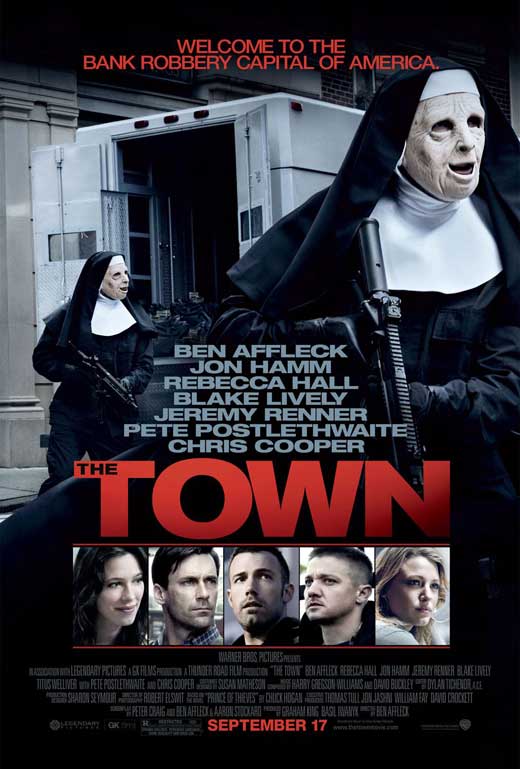
Movie Review: The Town (2010)


Directed by Ben Affleck


Everyone loves seeing someone get a second chance. Okay, so not everyone, but the great mass of humanity does, especially when we feel like people deserve it. Usually, all that entails is getting to know the person and feeling like they aren't a prick, that somewhere inside they're just like you and me and every other regular slob punching the daily human card. The power of a well told story is such that it allows us to see from the perspective of someone who, if we didn't know them, knew only their resume, we wouldn't be that interested. And if ever there was a test of that notion, it's Ben Affleck's new film The Town.

Affleck is the star of the movie, and the director and co-writer as well. In The Town he plays a not-so-hardened, but tough enough criminal, Doug MacRay, who's family legacy is theft and heart break. As a director, it's his second feature, following on the heels of his critically acclaimed Gone Baby Gone in 2007. As a person, well, for someone who had great success early, before becoming tabloid fodder following a number of questionable roles and dubious performances and sensational love interests, it isn't his second chance exactly, but it still feels that way. And if it is his remaking, he's doing a hell of a job with it. The Town proves, beyond doubt, that Gone Baby Gone was no fluke. It is an efficient, crisp thriller with a surprising amount of humour and no logic gaps to speak of, no moments where you wonder how a certain plot hole was so conveniently filled.

When you're remaking yourself, it helps to have Jeremy Renner along for the ride. The Best Actor nominee from The Hurt Locker provides gravitas as Affleck's lifelong friend and burgeoning sociopath who understands only two things: loyalty and violence. Renner is a name you'll be hearing more from, by the way. He may not have the looks of Pitt or the range of Depp (he just may, but he reminded me here of his character in S.W.A.T.), but he provides a great deal of the weight of the film. One wonders what The Town would have looked like without him. Jon Hamm is here as well, as FBI Special Agent Adam Trawley, but his performance provides none of the nuance he displays on a regular basis for Mad Men, the multiple Emmy award winning show in which he is the lead. (It's a disgrace he hasn't won an Emmy for his work there, but in The Town, he is merely adequate.) The only other performance worth mentioning is that of Blake Lively, who plays Renner's sister and Affleck's long-time love interest. Whatever has been said about her, she is flat-out terrific here. I suspect she'll be receiving more than a few calls from directors in the near future.

We can all wax philosophically about Affleck's career – as I was leaving the theatre I heard the couple behind me discussing how much better he was as a director – but the truth is that he's immensely likable and remarkably generous, both as an actor and director. And like his character in The Town, it's easy to overlook his mistakes and cheer for him anyway. Still, it wouldn't be enough if the movie was bad, or even average. It's so much better than that. Without question, there are some movie cliché moments, ones that make you sigh if not roll your eyes, and there were times in the theatre when a portion of the fifteen hundred people sitting around me laughed even after a sequence of surprising violence. But the applause (it was a TIFF showing) after the movie was long and generous, much like the man who made it.

Second chances are as much about the way the story is told as the one who the story is about, and to that end, Affleck succeeds in motivating the audience to cheer for his MacRay, a criminal capable of nasty things, but one who desires a second chance. Make no mistake, The Town is populist fare, with shootouts and action scenes and witty dialogue, but you get the feeling that as much as we're cheering for MacRay the criminal, we're cheering Affleck too. If the response from the audience were any indication, it looks like the man we once called Bennifer is on his way, and I, for one, am excited about it.

***1/2 stars (out of five)


Copyright Stephen Burns 2010


Friday, September 17, 2010

Movie Review: Passion Play (2010)


Directed by Mitchell Glazer


Most of us don't realize it, but our brains do not register concepts or ideas. They don't store information like a computer either, in ones and zeros. Rather, it does all that needs to be done, the sorting and predicting and shuffling through the endless torrent of stimuli, with pictures and emotions. From the most abstract concepts of math and physics to the most widely known, such as love, our brain works only with pictures and emotions. That makes a visual medium such as film an ideal place to explore simple concepts in new and profound ways. Perhaps new is the wrong word, as some film goers immediately sense that you are talking about some new film maker that artistes consider brilliant but that most of us can't follow because the story itself is abstract. Sometimes simple is better. Sometimes smaller is better. And sometimes it takes a single frame, a single illustration to remind us again why film is the single most powerful and prolific story telling tool we have. That is, when it's done well. And in Passion Play, it's done very well indeed.

Mickey Rourke stars as Nate Poole, a washed up, former jazz star in Mitchell Glazer's new film Passion Play. Rourke revitalized his career with a tremendous performance in Darren Aronofsky's The Wrestler two years ago, which earned him an Academy Award nomination, and apparently some good scripts from which to choose. Once again, he has chosen well. Rourke is 58 now, so unless you're of a certain age, you won't recall how Rourke, always a physical specimen, was a rising screen star in the 1980's, perhaps culminating in his performance with Kim Basinger in the erotic drama 9 1/2 weeks. His life then became a cautionary Hollywood tale of hard living and bad choices, not the least of which was his decision to go back to professional boxing, and the subsequent plastic surgery needed restore some of the damage the boxing had done, which only made it worse. These days, the looks are gone, but the presence remains. If anything, as he showed in The Wrestler, and even further here, the once vaunted physicality has been whittled around the edges, like a smooth piece of driftwood, and so there is little about him that isn't natural. In Passion Play, the raging emotions and energy crackle to life in his character, Nate Poole, but not often. Nate has been beaten down, buried under a sea of politics and passions and excuses every drug user knows, managing to survive, but only just. From the world of excess and celebrity, he has found an existence crawling amidst the night dwellers and dealers, the brokers of cheap rent and rummaged lives. There is something still alive in Nate, you can hear it in his music, but it no longer finds its way to the surface. But then, why would it? What good is strength and hope when you realize that those things belong only to the people who have chosen pragmatism, for people who dwell in the normative and who have controlled their emotions and affections for a life more stable? For someone like Nate, the world makes little sense outside of the clear, soft jazz of his trumpet. It probably never will. Who do you trust when you no longer even trust yourself?

There's been a lot written about Megan Fox, who became a star after her performance in Transformers. Unfortunately, when you watch Michael Bay's camera linger on her smooth stomach in that movie and listen to the playboy director discuss his casting decision, you understand the reasons behind the talk. Add to it some other wooden performances and her first leading role, in Jennifer's Body, that only reminded most critics of the decision behind her role in Transformers, and you understand why there was so little to expect from her here, even alongside Rourke. In Passion Play however, Fox gives a performance that should end the discussion about whether or not she can act. Yes, there are moments when you feel her shifting to Soap Opera emoting, the standard for beautiful young Hollywood actresses, but whether it's Glazer's direction or the strong script or the role that calls for something new, those moments are rare. For most of the film, she's actually something of a revelation. She plays against her type, and while certainly the camera and story frame her beauty, it does so in a way you do not expect. As the film progresses, you forget that she is "The Megan Fox", the one criticized and posterized for everything from her previous roles to her plastic surgery to her private life. Instead, it feels as though she is discovering new things through her character, new things about who she is and who she chooses to be, and she shyly invites us all along for a glimpse into her journey.

More than anything else, Passion Play is a look into the lives of people who have been broken, but deep inside still hold out for the faint hope of something more. Of something greater than the numbers, the ones and zeros that too often characterize our daily existence. Throughout the film, Glazer never cheats, never reaches beyond the characters, until one soaring moment when the simple but abstract idea that drives the movie reveals itself in a frame where picture and emotion finally meet onscreen. And when they do, we are lifted along with the characters, through our own remembrances of journeys past and journeys lost, washed away, for a while at least, in the hope of something greater.

****1/2 stars (out of five)

Copyright Stephen Burns 2010


Thursday, September 09, 2010

Movie Review: Crazy Heart (2010)


Directed by

Scott Cooper

I've never really understood the appeal of old country music. Guys like Waylon Jennings, whose name I know only from the Dukes of Hazzard theme song, twanging away on their gee-tar and sipping back grandpa's whiskey. For most of my life it has been the one type of music, along with death metal, that actually irritated me. The storytelling in it is bland, the music is three chords, and the lyrics are sappy and melodramatic. What the hell am I supposed to do with that?

I'd heard the buzz around Crazy Heart even before its star, and one of my favourite actors, Jeff Bridges, finally won his first Oscar for his role in it. Even then, I still wasn't sure if I wanted to see it. If I didn't get old country music, why would I want to see a (fictionalized) movie about an old country music star? I wasn't sure that I saw the relevance. (This is what happens when you don't have to review movies as part of your job.) A couple of friends encouraged me to check it out however, and so I sucked it up and prepared for yet another boring, two hour ride into the latest bio-musical pic.

Boy, was I wrong. From the opening scene, I became immersed somehow into this culture, into this old country lifestyle that I'd never understood. The best movies all do this, of course, but some cultures are more difficult to translate to the screen, and even more when the translation is contingent on a type of music that typically needs its surroundings as much as it needs its musicians. But the seamless storytelling and presence of Bridges, who is mostly unrecognizable throughout, provide all that's needed to make the film, and its subject, completely accessible.

Bridges plays Bad Blake, a former old country star, a la Jennings, who hasn't recorded a hit in a long time, and the movie draws us in as we follow Bad into the contradiction that is the world of country music. There's the claustrophobic night life, coloured bright and smoky in seedy bars and hotels and backend bowling alleys. Here the people come, looking to him for reminders of past glories, of dreams past and dreams lost, dreams that fade in time but somehow resonate in the clear baritone of an old man's voice and an old man's song. When the songs fade, and the night along with it, we're thrust into the harsh daylight, a transition made difficult by the wide open spaces and burning light of the desert sun, a sun that seems to crackle onscreen with every aching step of Bad's weathered cowboy boots and every crunch of gravel beneath the tires of his old, worn out truck. By turns his stubbornness and sadness, his anger and hope, percolate and boil over, all of it in tune with the contradictions of the land and the music, between the soft kisses of moonlight and withering noon glare of the Texan sun. Like a carefully balanced song, we feel the inevitable change sweeping through a life that must somehow come to a decision, one that will dictate whether his music will follow his weary heart or if somehow he will find the courage to strum new chords in the future.

Maggie Gyllenhaal is here, and while her intelligence and "old-youngness" make her the perfect choice for this role, her character needed perhaps an extra scene or two. We can surmise a few things from what she says, but in a film as deliberate as Crazy Heart, it should be in the script. Colin Farrell has a small but important role here as well, with an understated but engrossing performance that reminds you what a great actor he can be when he's not making blockbusters. He needs to do more roles like this one.

Ultimately, the movie rests on Bridges, and he delivers one of the best performances of his career. He's more open here than we're used to, more vulnerable than we've seen him since his terrific performance nearly twenty years ago in The Fabulous Baker Boys. It must be said however, that this is not another Ray; it is not merely a showpiece for a great actor. Crazy Heart, at its core, is a story about life, about what happens when we stop believing in the future and when our yesterdays surpass our tomorrows.

I think that's why I never liked old country music. It always seemed so focused on the past. But maybe I missed the point. Maybe the idea is that thinking about the past is not only a good thing, but necessary, if we want to find our future. Too hopeful? Too simple? Perhaps, but then, there's power in the simple answers, so long as we're willing to listen. After watching Crazy Heart, I might finally be ready.

****1/2 stars (Out of Five)


Copyright Stephen Burns 2010


Wednesday, September 01, 2010

Movie Review: The Other Guys (2010)


(2010)

Directed by Adam McKay

We're all still waiting for the great Will Ferrell comedy, the Liar Liar or Pink Panther or even Wedding Crashers that catapults him into the final stratosphere for comedic actors. After watching The Other Guys, it's clear we'll be waiting for a while longer. That isn't to say however, that The Other Guys isn't worth seeing. In fact, it lets you know right away that you're in one of the good Will Ferrell movies. For one thing, you're laughing almost immediately. The situation (Will Ferrell as a…) is only slightly absurd and he's paired with an actor who can play it straight and funny (Mark Wahlberg). The biggest difference between good Ferrell (Talladega Nights, Anchor Man) and bad Ferrell (Semi-Pro, Blades of Glory) however, is that he has a director capable of constraining him. In this case, it's Adam McKay. It's odd to say about a comedian who's so physical, but Ferrell is better when he's doing his thing with facial expressions and ridiculously obvious but inappropriate comments. What most people miss is that a large part of that comes from the goodwill he generates with his bumbling, innocent persona. (Have we ever seen an actor so political that is welcomed so easily on both sides of the aisle?)

In The Other Guys, Will Ferrell is an accountant/police officer who loves his desk job. His partner, Mark Wahlberg, is a former up and coming detective who's been forced to pair with Ferrell because of an unfortunate incident earlier in his career. Together, they get an opportunity to go after "a big one." It's a buddy cop movie with the twist that these buddy cops are clearly not heroic types.

In terms of straight guys, Wahlberg is good. As much as we've grown to appreciate his action abilities, he's just as good doing comedy. Unfortunately, his character here isn't defined as clearly as it needs to be. There are too many inconsistencies, and too often you find yourself saying "how can he do that?" I'm quibbling though, because when the two stars are arguing or "starting fresh", the chemistry is legitimate and funny. Eva Mendez has a role as the "perfect wife", as last played by Cameron Diaz in There's Something About Mary, and she handles it well enough. (She's asked to be hot, and she comes through with, err, flying colours)

Ferrell's movies, even his best, remind me a bit of Adam Sandler's work. There's funny stuff there, but the work feels incomplete. Especially in the second half of the films. And make no mistake, the second half of the movie is the difference between a great comedy and a good one. A great comedy makes you laugh all the way through and somehow manages to be poignant while twanging slightly on your heartstrings. A good comedy, which is hard enough, merely makes you smile and laugh. In that, The Other Guys is a good comedy. There's a number of laugh out loud moments, a great deal of smiling, and a buffet of quotables for the water cooler. We still haven't seen a great Will Ferrell comedy, but The Other Guys is another good one, and seeing as how rare that is these days, that will do for now.

**** (Out of Five)

Copyright Stephen Burns 2010


Sunday, August 29, 2010

Movie Review: Salt (2010)


Directed by Phillip Noyce (2010)


No Spices Needed

Go see it. It's a damn good thriller.

Since this is a spoiler-free movie review, there's only so much you can say about a thriller with the tagline: Who is Salt? What I can tell you can be summed up in seven words (above), but I'm not sure how convincing it would be if I read a review like that, so let's delve into what we can tell you.

As I've mentioned in other reviews, Angelina Jolie is the most convincing female action hero alive. The only one close is Milla Jovovich (Resident Evil) and she's really a distant second. The script for Salt cements Jolie's action icon status by doing something a bit different: it keeps her dialogue to a minimum. She speaks, but there are long stretches of the movie where she carries it with her kinetic energy and charisma alone. And her eyes. There's a lot going on in the close-ups, not the least of which is an impressive array of emotions and a fierce intelligence that has not only seen it all, but lived it as well.

As we now know, the part was originally written for Tom Cruise, who chose Knight and Day instead, and the script was altered to fit Jolie. Although Cruise could have handled it (his action prowess is underrated) Jolie is a better fit here. Her ability to carry ambivalence as well as emotional complexities is better suited to the role. There's weight to her, a certain sadness, that makes the movie more than the sum of its parts. And its parts are good. Schreiber is excellent, as he always is, and I'm still confused why he isn't a star. Is it because his first name is Liev? I'm not talking about race, but simple pronunciation. He brings tangible believability to every role he plays. And in a thriller that never stops from the moment it starts, you need actors to help provide heft for their characters, because even great action scripts don't have much time for character development.

The film is shot in a linear fashion, and cut quickly, but it's easy enough to follow. It's a simple way to distinguish good action movies from the rest. Bad action films are cut and thrown together like an overcooked stir-fry -- you never know what vegetable you're eating because they all taste like chicken. That never happens in Salt, which grips you from the opening scene and never lets go. It reminded me at times of The Bourne Identity, albeit for different reasons. (And no, Salt is not about amnesia.) When the movie ended I looked at my watch in surprise. I hadn't even noticed the time.

As for the themes of the movie, I think you'll be surprised at some of the questions that might come up on your way out of the theatre. And even if there's no discussion, there's one thing you'll all be able to say to the people waiting for the next showing; "Go see it. It's a damn good thriller."

**** (out of five)

Copyright Stephen Burns 2010

Thursday, August 19, 2010

Movie Review: Death at a Funeral (2010)


A Very Slow Death…


Directed by Neil LaBute


Death at a Funeral is a farce, based on the 2007 British film of the same name. I wish I'd known that before I watched it. I'll be honest, the farce may be a theater tradition, but most of the time they're just stupid. It's an intellectually redundant form of broad based comedy, the idiot relative of its more refined cousin, satire, which actually requires thinking. And generally speaking, the only thing worse than a French or British farce, is an American one. It simply doesn't work in Hollywood because big American films are always trying to make sure that everyone is happy at the end. That's assuming, of course, people GET to the end. I first checked my watch about forty-five minutes into the movie. I checked it again about ten minutes later. At one point I yawned, and it was only 9:30pm. So, that wasn't a good sign. But maybe I should go back to the reason I watched the movie in the first place.

Some of you may not remember, but when Chris Rock released his 1998 HBO special, Black and White, there were many, myself included, who considered him the preeminent comedian of his generation. Perhaps the closest thing to the reincarnation of a young Eddie Murphy. Unlike Murphy however, Rock was never able to transform his stand up success to movies, not in a starring role, at least. Lawrence, on the other hand, was a box office power for a short time in the late 1990's. In many ways, he was the antithesis of Rock; a sometimes funny stand up comedian whose stylings did translate into some big hits. Then Hollywood paid him $20 million to do Black Knight, he became arrogant, and was never the same.

All comedians are angry, but when they become arrogant – that is, when their arrogance infects their comedy – they lose their mass appeal. Ever wonder why Adam Sandler is still popular? The anger, and therefore the humility, real or not, is still evident in his work, and people can still identify with him.

As for this typically unfunny farce, well, there isn't a lot to say. There's a funeral, obviously, and some well known actors playing types. I already mentioned the two leads. Luke Wilson is himself. Tracy Morgan is himself. Regina Hall acts as though she's still working with the Wayan brothers. (Psst. This isn't another Scary Movie. You don't have to squeak your voice on every line reading.) Danny Glover is a grumpy, wheelchair bound grandfather. Zoe Saldana is here, although I'm not sure why. Seems like she's accepted every acting offer since Avatar. She probably would have been more effective here in the blue, ten foot body, with the long tail. None of these actors are ever funny. Oddly, the only laughs in the movie come from James Marsden. His frazzled character is the only one we actually believe.

Death at a Funeral never lets you inside. You never get the sense that the movie cares about its idiot characters, perhaps it's not supposed to, and consequently, doesn't care about you either. The best part of the movie was checking the display on my DVD player and realizing there were only nine minutes left. The movie is 89 minutes but feels much, much longer. If the purpose of this farce was to slow down the minute hand on my watch, the movie is a tremendous success. Otherwise, you'll wish you were the one in the casket.

* (out of five)

Copyright Stephen Burns 2010


Wednesday, August 11, 2010

Review: Clash of the Titans (2010)


Directed by Louis Leterrier


(2010)


This looks like a great summer flick. That's what you're thinking through the first twenty five minutes or so of Clash of the Titans, a 2010 remake of the campy 1981 cult classic. In the 2010 version, the sets and costumes are well done, the actors are determined, and the special effects are competent. But about halfway through this story of a demi-god, Perseus, who must complete certain heroic tasks to save the city of Argos from the gods, something changes. Oh, everything still looks good, but you realize that you don't care all that much. It isn't the fault of the actors, although Liam Neeson's Zeus looks, and sounds, like someone playing Santa at an office Christmas party. The star here is Sam Worthington, who plays Perseus, but the script gives no time for character development. Worthington, who was good in Terminator: Salvation and even better in Avatar, does his best, but his Perseus is a one note hero. He's Russell Crowe without the sadness, and consequently, the ballast, for us to care about him that much. And while the demi-god is insistent throughout the movie that he is choosing to be human, you don't believe it. He sounds like someone helping at a soup kitchen for a couple of days, who then looks forward to telling his other rich friends about his experience "relating to the people" over a bottle of Bordeaux. For an adventure story to work, you have to empathize with the hero. You have to believe that they are both fallible and flawed, and that's just not the case here.

Watching big, expensive adventure movies like this makes you appreciate the greatness of The Lord of the Rings, and the reason why the source material is so important. The original Clash of the Titans, with Harry Hamlin, evoked a great deal more emotion, despite its camp. Perhaps its inability to rely on special effects made it so. In this remake, while the special effects are competently done, the fight scenes serve nothing but to advance to the next set piece, and push the viewer away from the story. You're looking for a controller just as the movie is supposed to get interesting. (Clash of the Titans video game was released for PS3 on July 27, 2010)

In that, the story probably serves better as a video game than a movie. I was looking forward to this one, but so long as The Suits insist on the "necessary elements of big budget movies," and don't allow their directors some creative freedom, they'll continue to serve up schlock like this that is neither interesting nor memorable. Trust me, you'll forget it as soon as it over. And when someone asks you what you thought, you'll be left wondering why it wasn't better, because it looked so damn good.

**1/2 (out of five)

-Steve

Copyright Stephen Burns 2010


Wednesday, August 04, 2010

Movie Review: The Man in our Mirror


This Is It (2009)


Directed by Kenny Ortega


About halfway through the movie I started to feel it, a gentle tug that had become more insistent until I slowly became lost in a sea of memories and quiet sadness. For people of a certain age, Michael Jackson is synonymous with adolescence. For us, he was more than a pop star. He was the closest thing we had to a global celebrity, a living Truman before the internet revolution decreed that every celebrity's life would be lived (literally)under continual scrutiny. From the stories of his childhood abuse (his dad used to sit with a belt across his lap when the Jackson Five rehearsed, and if they made a mistake, he would whip them) to his culture changing stardom with Thriller, and from his move from icon to iconoclast to creepy Wacko, Michael Jackson was always a presence in our life.

That is, until the past decade. Somehow, we needed the absence. Needed the separation. But with the distance something happened. Somehow his decade long absence served to bury Jackson the pop star and raise him to something else altogether. This Is It was to be his comeback, and perhaps, final tour. And what a tour it might have been.

The movie is compiled footage from his concert preparation, and cut in a manner to be a concert, in effect, for the viewer. It's well done, although more interviews would've helped the narrative along. Despite that, Jackson's star power is never in question. With his translucent white skin and sunglasses balanced over a porcelain face of sharp mounds, he seems more a ghost than a fifty year old man. His voice is still crisp, and his conditioning is tremendous, as he dances and sings with every song. (Unlike, say, Brittney Spears or any number of current pop stars) His creative vision is astounding, and even from the half finished clips we see in the film, we know that This Is It would surely have been one of the greatest (and most expensive) shows of all time.

Mostly though, it isn't Michael the performer that holds you. It is the force of the memories dancing along inside you when he sings Thriller and Man in the Mirror, the soft, childish platitudes he mutters to his crew that strangely fill you with hope, and the love his dancers and fellow musicians genuinely hold for him.

It's easy to be cynical about Michael Jackson, easy to call him Wacko Jacko or a creep, but for four decades he lived in front of us, startling us and disappointing us, and yet, always creating those moments. Moments we recall twenty years later that remind us who we were back then, and in so doing, help us see what we have become.

More than his musical and creative genius, his dominance of pop culture was the result of his ability to help us look in the mirror and to do so not with cynicism, but hope. Michael Jackson was not a saint, nor was he just another celebrity sinner. He was, in a strange way, the perfect reflection of our ideals and failures, an adult of great charity and a child who never grew up. And in that, he was just like us.

***** (Out of five) For the memories
***1/2(Out of five) For the film

Copyright 2010 Stephen Burns