Friday, September 24, 2010

Is It Love… or the Idea of Love

I'll never forget it. It was a night much like this one, loosened white swirls against a blackened night, stars glittering like veiled sequins across God's canvas. I'd stayed home that evening. Gone for a late walk after midnight. The dreams had come fiercely, and while I'd known their fierceness in the past, the past month had been something new. Something desperate. Something needed. The street had been quiet, as always, as I stumbled towards the small house that I, along with my ten housemates, now called home. And yet, I couldn't go inside. With every glance at the stars I found sadness, a great, unvarnished look into a heart that lay quietly dying. It shouldn't have been surprising. Not for someone who prided himself on his self-awareness and tendency towards introspection. But we all have blind spots, especially in matters of the heart. That was the night I realized that while I had known love, what I'd known better was the idea of love. I saw how it had sustained bad relationships. Saw how I had fooled myself into believing that they were the same. Realized that whatever I knew about love, most of it was second hand, lines from movies and well written discourses on the greatest of human mysteries.

That night I asked God for a second chance.

***

We don't realize it, but beyond the oil and consuming, the concept of love drives Western culture more than anything else. All of our art forms are faithful in their dedication towards her. And yet, love is mostly a new thing. We write her into our historical novels and plays and movies, we read psalms and poetry that endeavor to unmask her power and enhance it, and still, we forget the truth behind these mythical notions. When it comes to romance, love is yet in her infancy. Most of what we read is misread, and most of the great love stories have been misrepresented. Love, as it exists in our minds and our culture, is less than a hundred years old.

Oh, I know, you'll hear the commentators scoff at such at notion. Love is eternal, they'll say. Love has always existed. And it has… but not in the romantic form with which we so deeply consider it now. Love, that which we see and feel in the moonlight and quiet music, exists only between equals. Do I really love someone who I consider less than myself? Do I really love someone who is not my equal? Perhaps, as a master loves a slave or an owner loves a pet. But what poet captures the imagination of the world writing an ode to their horse or dog? We may not like it, but the idea of love is the blinding light of a society that claims equality but does not grant it. It is the fruit on the dish of ice cream that talks of healthy eating. Worse, the idea of love is sold as the real thing. It binds men and women in unequal relationships, and creates new stories, new myths, to convince people that what they experience is in fact, the ideal. So hungry are people for the real thing that we will swallow the lie, the new myths (which are nothing more than the retelling of old stories), and believe that we have indeed, found love.

It is impossible to count how often we hear the word 'love', during our daily routine, suffice to say that we hear it enough to diminish her meaning and power. Everyone loves everyone, and all who find themselves in romantic entanglements admit to love, though most people are not happy. That sounds harsh, but how else do we explain the separation of people who have said they love each other? How else to explain the domestic violence so rampant throughout our culture? And the church is not exempt. Both the rates of divorce and domestic violence are higher in the church than for those outside the church. (Though not by much) Somewhere, somehow, we have convinced ourselves that the most important part of our life is that it is shared with someone else. More than simply status, she is the very manner in which we define ourselves and the success of our lives. And so, we cannot tell if it is love, or the idea of love, with which we are so enamored.

The end result is not pleasant. We are given books and writings designed to help us create love and stimulate love, and yet no one mentions just how mysterious she is, or how uneasily she should be defined. She is young still, and most often those that claim to know her know only what others have told them. The best relationships are often unexplainable, and offer only hints as to their vitality. For as much as we'd like to duplicate its impact, love has not easily surrendered her secrets.

***

I have been in love before, but until these past two years, I have not truly known her power. How could I? I believed that men were superior to women. We still teach that, you know. Especially within religion, though not exclusively so. In fact, great swaths of our society teach the greatest obstacle to love as a pathway to her arms. Its sadly ironic, but mostly sad. In the theatre of our romantic discourse we discuss roles and obligations, lists and keys for both sexes, pitfalls and pragmatic tips for finding the most mysterious of human giftings. And still, she eludes us. So much so that we settle for the idea of love, and make excuses for both our failing to find her and the relationship we find ourselves in, which we know lacks her presence.

I once thought that if I ever knew what love was, if I ever had another chance at her, that I would be able to offer advice to the many people starving for a taste of her presence. I was wrong. The more I find her in my relationship with my wife, the less I comprehend. I do not know why she graces us with her presence, and I do not understand why she has chosen me. What I do know is that one night I stood beneath the stars and asked for a second chance. And God, the One who identifies himself as love, saw fit to answer my prayer.

For all of her wonder, love is the most humbling presence of all, and to have discovered her so late in life is a gift beyond words. My hope is that you will not falter when the world offers you the idea, and wait instead for her beguiling presence, a presence that will shift the very core of your being. She is young still, this love, but she is powerful beyond words. And if she touches you, your life will never be the same.

-Steve


Sunday, September 19, 2010

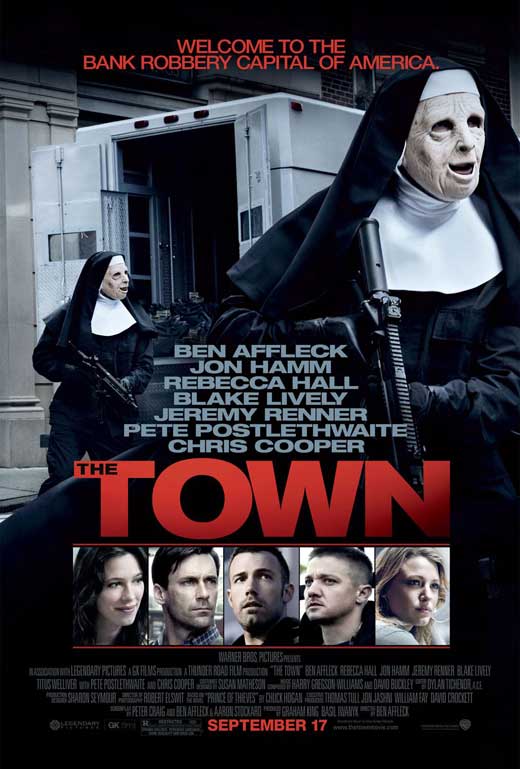
Movie Review: The Town (2010)


Directed by Ben Affleck


Everyone loves seeing someone get a second chance. Okay, so not everyone, but the great mass of humanity does, especially when we feel like people deserve it. Usually, all that entails is getting to know the person and feeling like they aren't a prick, that somewhere inside they're just like you and me and every other regular slob punching the daily human card. The power of a well told story is such that it allows us to see from the perspective of someone who, if we didn't know them, knew only their resume, we wouldn't be that interested. And if ever there was a test of that notion, it's Ben Affleck's new film The Town.

Affleck is the star of the movie, and the director and co-writer as well. In The Town he plays a not-so-hardened, but tough enough criminal, Doug MacRay, who's family legacy is theft and heart break. As a director, it's his second feature, following on the heels of his critically acclaimed Gone Baby Gone in 2007. As a person, well, for someone who had great success early, before becoming tabloid fodder following a number of questionable roles and dubious performances and sensational love interests, it isn't his second chance exactly, but it still feels that way. And if it is his remaking, he's doing a hell of a job with it. The Town proves, beyond doubt, that Gone Baby Gone was no fluke. It is an efficient, crisp thriller with a surprising amount of humour and no logic gaps to speak of, no moments where you wonder how a certain plot hole was so conveniently filled.

When you're remaking yourself, it helps to have Jeremy Renner along for the ride. The Best Actor nominee from The Hurt Locker provides gravitas as Affleck's lifelong friend and burgeoning sociopath who understands only two things: loyalty and violence. Renner is a name you'll be hearing more from, by the way. He may not have the looks of Pitt or the range of Depp (he just may, but he reminded me here of his character in S.W.A.T.), but he provides a great deal of the weight of the film. One wonders what The Town would have looked like without him. Jon Hamm is here as well, as FBI Special Agent Adam Trawley, but his performance provides none of the nuance he displays on a regular basis for Mad Men, the multiple Emmy award winning show in which he is the lead. (It's a disgrace he hasn't won an Emmy for his work there, but in The Town, he is merely adequate.) The only other performance worth mentioning is that of Blake Lively, who plays Renner's sister and Affleck's long-time love interest. Whatever has been said about her, she is flat-out terrific here. I suspect she'll be receiving more than a few calls from directors in the near future.

We can all wax philosophically about Affleck's career – as I was leaving the theatre I heard the couple behind me discussing how much better he was as a director – but the truth is that he's immensely likable and remarkably generous, both as an actor and director. And like his character in The Town, it's easy to overlook his mistakes and cheer for him anyway. Still, it wouldn't be enough if the movie was bad, or even average. It's so much better than that. Without question, there are some movie cliché moments, ones that make you sigh if not roll your eyes, and there were times in the theatre when a portion of the fifteen hundred people sitting around me laughed even after a sequence of surprising violence. But the applause (it was a TIFF showing) after the movie was long and generous, much like the man who made it.

Second chances are as much about the way the story is told as the one who the story is about, and to that end, Affleck succeeds in motivating the audience to cheer for his MacRay, a criminal capable of nasty things, but one who desires a second chance. Make no mistake, The Town is populist fare, with shootouts and action scenes and witty dialogue, but you get the feeling that as much as we're cheering for MacRay the criminal, we're cheering Affleck too. If the response from the audience were any indication, it looks like the man we once called Bennifer is on his way, and I, for one, am excited about it.

***1/2 stars (out of five)


Copyright Stephen Burns 2010


Friday, September 17, 2010

Movie Review: Passion Play (2010)


Directed by Mitchell Glazer


Most of us don't realize it, but our brains do not register concepts or ideas. They don't store information like a computer either, in ones and zeros. Rather, it does all that needs to be done, the sorting and predicting and shuffling through the endless torrent of stimuli, with pictures and emotions. From the most abstract concepts of math and physics to the most widely known, such as love, our brain works only with pictures and emotions. That makes a visual medium such as film an ideal place to explore simple concepts in new and profound ways. Perhaps new is the wrong word, as some film goers immediately sense that you are talking about some new film maker that artistes consider brilliant but that most of us can't follow because the story itself is abstract. Sometimes simple is better. Sometimes smaller is better. And sometimes it takes a single frame, a single illustration to remind us again why film is the single most powerful and prolific story telling tool we have. That is, when it's done well. And in Passion Play, it's done very well indeed.

Mickey Rourke stars as Nate Poole, a washed up, former jazz star in Mitchell Glazer's new film Passion Play. Rourke revitalized his career with a tremendous performance in Darren Aronofsky's The Wrestler two years ago, which earned him an Academy Award nomination, and apparently some good scripts from which to choose. Once again, he has chosen well. Rourke is 58 now, so unless you're of a certain age, you won't recall how Rourke, always a physical specimen, was a rising screen star in the 1980's, perhaps culminating in his performance with Kim Basinger in the erotic drama 9 1/2 weeks. His life then became a cautionary Hollywood tale of hard living and bad choices, not the least of which was his decision to go back to professional boxing, and the subsequent plastic surgery needed restore some of the damage the boxing had done, which only made it worse. These days, the looks are gone, but the presence remains. If anything, as he showed in The Wrestler, and even further here, the once vaunted physicality has been whittled around the edges, like a smooth piece of driftwood, and so there is little about him that isn't natural. In Passion Play, the raging emotions and energy crackle to life in his character, Nate Poole, but not often. Nate has been beaten down, buried under a sea of politics and passions and excuses every drug user knows, managing to survive, but only just. From the world of excess and celebrity, he has found an existence crawling amidst the night dwellers and dealers, the brokers of cheap rent and rummaged lives. There is something still alive in Nate, you can hear it in his music, but it no longer finds its way to the surface. But then, why would it? What good is strength and hope when you realize that those things belong only to the people who have chosen pragmatism, for people who dwell in the normative and who have controlled their emotions and affections for a life more stable? For someone like Nate, the world makes little sense outside of the clear, soft jazz of his trumpet. It probably never will. Who do you trust when you no longer even trust yourself?

There's been a lot written about Megan Fox, who became a star after her performance in Transformers. Unfortunately, when you watch Michael Bay's camera linger on her smooth stomach in that movie and listen to the playboy director discuss his casting decision, you understand the reasons behind the talk. Add to it some other wooden performances and her first leading role, in Jennifer's Body, that only reminded most critics of the decision behind her role in Transformers, and you understand why there was so little to expect from her here, even alongside Rourke. In Passion Play however, Fox gives a performance that should end the discussion about whether or not she can act. Yes, there are moments when you feel her shifting to Soap Opera emoting, the standard for beautiful young Hollywood actresses, but whether it's Glazer's direction or the strong script or the role that calls for something new, those moments are rare. For most of the film, she's actually something of a revelation. She plays against her type, and while certainly the camera and story frame her beauty, it does so in a way you do not expect. As the film progresses, you forget that she is "The Megan Fox", the one criticized and posterized for everything from her previous roles to her plastic surgery to her private life. Instead, it feels as though she is discovering new things through her character, new things about who she is and who she chooses to be, and she shyly invites us all along for a glimpse into her journey.

More than anything else, Passion Play is a look into the lives of people who have been broken, but deep inside still hold out for the faint hope of something more. Of something greater than the numbers, the ones and zeros that too often characterize our daily existence. Throughout the film, Glazer never cheats, never reaches beyond the characters, until one soaring moment when the simple but abstract idea that drives the movie reveals itself in a frame where picture and emotion finally meet onscreen. And when they do, we are lifted along with the characters, through our own remembrances of journeys past and journeys lost, washed away, for a while at least, in the hope of something greater.

****1/2 stars (out of five)

Copyright Stephen Burns 2010


Wednesday, September 15, 2010

From the Archives: Church is for Women… Or is it?


Authour's Note: As I explained in this tab, occasionally I'll be wading through old articles I've posted. Part of that is to help me chronicle my own journey, and part of it is to shed light on just how much our views change through the years as we experience different things and learn from past mistakes. This article was posted originally on Saturday January 20, 2007, nearly three and a half years ago. Aside from the writing, which needed some editing but still didn't thrill me, the view here is one I now disagree with in a variety of ways. Following the article, I'll post my follow up, which I'll keep to five hundred words. (And if you've been on this blog before, you know that five hundred words is truly a summation for me.)This post, by the way, is dedicated to my friend Zack, who suggested this idea. Hope you enjoy the new feature, everyone. As always, comments are welcome.

Church is For Women

The door jingled as I walked inside Blessings, the small Christian bookstore I'd found when I'd first moved to Ottawa. I strolled through the store, amidst the tables of nic nacs and Jesus figurines while the music played softly in the background. Every time I entered a Christian bookstore I had a strange sense that I was walking into a women's section of the library. It hadn't bothered me in the past, as I was more at home in quiet bookstore than I was in a garage. Lately, however, I'd started to notice things. Mainly, I'd come to notice just how feminine the church had become.

I headed to the men's section. I browsed through the titles, and went to another aisle before realizing that the men's titles were all located on just the one shelf. Slim pickings. As usual. It wasn't the publisher's fault however, as every Christian writer knew that women purchased more than 85% of any books sold through Christian retail. No wonder they tailored their stores – with the soft music and rose colored walls – towards women. Still, it made me shake my head. When I finished my shopping and headed out a few minutes later, I wondered if my friends would have been comfortable in a store like that. Might as well be buying flowers.

Lately I'd been doing a fair bit of reading about the church, in particular the place of men within the church, and lately I'd begun to notice some discrepancies, discrepancies that had me and some others worried. Particularly the lack of men, especially 'manly men', in the church. I'd never really noticed it before, but there was a reason for that. The statistics for church attendance were alarming. George Barna had found a gender gap of over 13 million (more women attending church) in the U. S. As well, twenty to twenty-five per cent of married women in the church were going alone. Any one who had worked in a church understood this. I remembered my time as a pastor. I remembered the women who came alone, and I remembered how much we (the pastoral staff) leaned on the women to run the programs. Except for the deacons, it was hard to find men consistently in the building. Perhaps one of the greatest misperceptions of the modern church was the idea that it was patriarchal. More like a frosted cake, below the frosting of ministers and clergy, still predominantly men, most of the church's programs were run by and for women. This whole idea about men 'missing' in the church was something of a revelation to me, understandable I suppose for the fact that I related to the men and women who attended church quite well. I was artistic. I liked small conversations. I liked teaching. I also enjoyed singing and music and learning. Unfortunately, most men just weren't built that way. I decided that the next Sunday I would step back and take a closer look at the Sunday service, which so many authors seemed to suggest had only become increasingly feminine.

The first thing that struck me was how NICE-ly everything was arranged, how NICE the people were, and how it fit with the elevator style music softly leaking over the sound system. I hung up my jacket and strolled into the sanctuary, greeting people along the way. By the time the service started, I'd already had about ten small conversations filled with warm fluff and lots of smiles. After brief announcements, we started singing. We sang for a good thirty minutes before one of our pastors and some others delivered some more announcements, all of which were presented in soft, smiling voices. Our senior pastor finally rose to speak, and after a short prayer, delivered a forty-five minute teaching that was both interesting and long. I say 'long', because as I imagined myself as a non-artistic man in the congregation, I wondered how good it felt to be back in school for an hour and a half every Sunday morning. Not only school, but taking a feminist course on relationships and submission and passive interaction. And then there was the soft music, the emphasis on relationships and small talk, the almost desperate longing for people to be NICE. And through it all, if you listened closely enough, you could almost hear the unconscious murmur... Don't rock the boat. We're all safe here. What was dangerous and manly about that? Where was the adventure and pulsing life that men longed for?

Church, for whatever reason, had become an exercise for women and artists and passive types who relished security over risk, who longed for relationship over greatness, programs over projects. Something had happened between now and that daring New Testament church that was filled with 'manly men', risk takers and adventurous types who understood that becoming a Christian did not mean more tea and crumpets. I wasn't sure what we could do about it, but it was something I needed to think about, because the more we excluded men from our churches, the more feminine they would become...

(RESPONSE)

A Feminine Church? Huh?

You notice it most often when you go out to a bar or pub and people are drinking, and therefore more uninhibited, but you see in restaurants, too. The harshness in conversations, the veiled threats, the simmering arguments, the passive aggressive comments, all made by people who have voluntarily chosen to be out together. Family, friends with friends, or worse, two people involved in some kind of romantic relationship. Coming out of the church "bubble", the one thing you notice almost immediately is how often people are NOT nice to each other. And while we can argue that too often we use "niceness" as a measurement for a person's character, it is the sign of social discipline to be in a place where niceness is prevalent, and it has nothing to do with gender. It's about safety.

When I wrote that piece nearly four years ago, I was immersed in church culture. Since then I've changed cities and moved twice, and haven't really found a church home yet. These days I'm well outside the bubble. I'm outside the safety of a place that's warm and welcoming and filled with genial small talk. I no longer see it as some kind of challenge to my supposed "manliness", whatever that means, but a welcome respite from most days where that social discipline does not exist.

The idea that a church needs to be more "manly", is frankly ridiculous. And while some of the erotic tendencies within the "worship music" industry are disturbing – as a straight male, singing about Jesus as my lover is, err, uncomfortable – the service itself no more reflects a feminine nature than a library (the woman section of the library, was I kidding?) or gym reflects its purpose. The purpose of meeting together each week as Christians is not to raise our own particular idea of gender awareness and compensate for our insecurities. It is a time of encouragement, meditation, and corporate prayer designed to help us push each other towards a life that better reflects that of Jesus. Or at least, our idea of Jesus.

The idea that "church" is feminine speaks primarily to men who feel that they have somehow lost the "adventure" within their own lives, which is a result of feeling emasculated by either their jobs or relationships. But addressing it through gender stereotypes is a disaster waiting to happen. In fact, I can't think of another, single thing more capable of destroying both individuals and relationships than this emphasis on what is male and what is female. A quick glance at other cultures and history books reveals that gender distinctions are as real a dividing line as the Prime Meridian. What they end up doing is creating more insecurity in those who do not "fit" the normative male or female patterns. (I love to dance. I love to read and write. Does that make me feminine?) According to my old way of thinking, women not only don't like adventure, they don't enjoy challenges or anything outside of shopping, flowers and children, either.

Understand that none of this has anything to do with what it means to be a Christian. Sure, it gives us a sense of being safe in our roles, but the problem being safe is what walked us down this road in the first place. Want more adventure in your life? Stop taking crap from others telling you what to do and who you should be, get on your knees, and figure it out. Involve yourself in programs with people who need help, people who will challenge you. And when you go out for dinner, just listen to the conversations around your table. More often than not, you'll wish you were in church.

-Steve