Showing posts with label Equality. Show all posts

Monday, February 01, 2016

Selling Out to Sell Books.

Am I too harsh in my public criticisms? Am I turning away potential readers because I insist on being so aggressive about certain issues on social media?

I've been wrestling with these questions for the past month or so, ever since The Last Angel was published. Writing is a business, and it takes a lot of work to build up a readership apart from writing great stories. For all the ease and availability of finding a book, it has become increasingly difficult to find readers. Turning off a potential reader to make a point about certain "hot" issues is risky.

In the past, I never even considered the consequences of such things. I didn't care if I lost a "friend" or "follower" over something I'd written. As a writer and observer of human nature, there were certain inequalities too upsetting NOT to comment on. (Like anything to do with animal rights/factory farming and social justice)

Unfortunately, when I did comment on these issues, subtlety was, err, not my strong suit. I can be abrasive when I believe our society or certain individuals are whiffing on a topic that revolves around kindness. I'm particularly aggressive when it comes to apathy. It's one thing to not be in a position to help (though I do think we can all help in small ways), it's something else entirely when people just don't give a shit.

And yet, am I really going to change anyone's mind? On Facebook? On Twitter? Probably not. So why say anything in the first place? And for heaven's sake, why be so damn obtuse about it? If it doesn't matter, then focus on the good things and sell a few more books. Don't be so political, and that way more people can enjoy your stories. You'll have less aggravation as well.

Sigh. (This is why you do not want to get inside a writer's head.)

I wrote about this a little while ago, although I attacked it from a different angle. Artists are NOT politicians. However, we sometimes have to be a little political, especially when you have a temperament like mine, to ensure that we don't anger people before they've even seen our work.

Or do we?

As proud as I am of THE LAST ANGEL, and as excited as I am for the release of three more books this year, I certainly haven't "made it." Not by a long shot. I'm still a starving artist. Still struggling to pay the rent. And yet, as much as those questions haunt me, there is one question that haunts me more.

Twenty years from now, when I look over my career, what will my legacy be? I can tell you that it won't be about the number of books I sell. (Though I would like to sell a lot, obviously.) I think, on that day, I will ask myself if I pushed for better in society. I will wonder if my stories were not simply entertaining, but if they asked the moral questions that all art should ask. I will think back to this time right now, when my future as a writer was very much in doubt, when I had no idea if I'd sell a hundred books or a hundred thousand of them, and ask myself whether I was more worried about myself, or this world I inhabit.

And if I can't say that my stories reflected my heart about issues like poverty, racism and bigotry, if I can't say that I strove to correct social wrongs with passionate tales of courage and redemption, and if I can't say that my works were nothing more than entertainment, then I will know that I have failed.

I do not want to be a failure.

That isn't to say that I do not hope to make a good living, of course i do, and it's not to say that perhaps I could tone down some of my comments on social media, if not the message. But I will not sell out to sell books.

THE MODEL 

I've written about this before, but the first positive portrayal of a gay man was a secondary character from one of Robert B. Parker's books. A tough, wise, funny cop. To that point in my life, all I'd heard about the LGBT community was that they were a bunch of perverts. I'm not exaggerating, and if some of you grew up in a small, conservative town like mine, you may have experienced the same thing.

That was the start of a journey for me. Along the way, that enriched worldview, or at least, that wider worldview, has been expanded to race and gender.

Books like Twillight and Fifty Shades sell millions of copies, all while giving women and girls terrible role models. Role models that suggest they need to "surrender" to men and that they aren't worth as much. Perhaps these books are popular because women Identify with those characters. Perhaps they are popular because they speak to the patriarchal worldview that still grips most of the world.

But I find it destructive. As a youth worker for nearly twenty years, these are not the models that I want young girls, sisters and daughters and nieces, looking up to.

That will not happen in my stories.

Will I lose readers?

Maybe.

Probably.

But I won't consider that failure.

Starting your own business, whatever it is, inevitably means compromise. But where? In this case, selling out to sell books is something I will work hard not to do, even if the questions still plague me from time to time.

Parker showed me that one could be successful novelist, tell thrilling action stories that people loved, and still make a point to change the world, even in a small way, by staying true to his principles. And in the end, that the goal for all of us, isn't it?




Friday, December 18, 2015

Artists Are Neither Politicians or Propagandists

I probably shouldn't be writing this post. Not with my debut novel about to break and three more in the series due out next year. I shouldn't be writing this because there's a very good chance I'm going to upset some people, people who might be potential readers. It might hurt my sales and someone who might have enjoyed my work will never give it a chance.

What I should do is shut my mouth and post something that won't offend anyone, something that will get eyeballs and clicks and possibly entice someone to check out my other work.

Except, I'm not going to do that. I'm an artist, not a politician. And when artists decide that sales are more important than what they're trying to say, they aren't artists any more. That's not to say that everything an artist writes or paints or creates needs to deal with serious political or societal issues. Hey, that's the same kind of bourgeois attitude I ripped the other day in my post about Star Wars. Writing coaches suggest that every writer will explore two or three themes in their life, and that all of their work will revolve around those themes, whatever they are. Sure, they could be things like class issues or equality or religious bigotry, but they could also be themes like the importance of family, certain political issues, or sibling relationships. It could be any number of things that an artist feels passionately about, whatever it is that draws them back to the empty canvas.

The choice of theme is not important. What's important that we never censor our opinion on that which gives our work life. As soon as we do that, we might as well print ads for a car company, because we aren't acting as artists anymore. As soon we allow our concern about our sales figures to edit our work even a little, we've taken our first step to becoming a politician. There's nothing wrong with wanting to be a politician or believing that you could make a difference in you ran for city council, but you can't be both.

ROBERT B. PARKER

I grew up in a small, white town circa. the 1980's, and the only thing I knew about the gay community was that they were sinners, perverts and gross. That's what I'd been taught. Don't get me wrong, my parents are extraordinarily kind, so were the people in my church, but as I didn't know anyone who was gay, and as there were no positive representations in the media (Ellen "Degenerate" Degeneres, remember that, ugh!) was still years away from getting her first sitcom on ABC), so I believed them. My stance tempered into my twenties, though I still believed it was sin. Still a perversion. Until I met Mr. Parker.

Well, I didn't meet him in person (That would have been great!), but I met him through his Spenser detective series, still my favourite all these years later. In his series, there was a minor recurring character, Lee Farrell, who was gay. He was tough and kind, a good cop. I'd never even fathomed that someone gay could be a tough cop. (Gay people were "fairies.") That didn't make sense. But it was my favourite series, and so the more I read, the more I started to question what I'd been taught.

That's right, my first positive gay role model was a fictional character.

I learned, years later, that Parker had two sons and that both were gay. Farrell was a secondary character, but for a diehard conservative like me, he was the first to crack open the door to my worldview and offer me a different look at the world. That single character would lead to further reading, and as I got older, I rejected my earlier notions about homosexuality. In fact, equality (a rejection of my misunderstanding of feminism as well) with regards to sexuality and gender and race is one of the prominent themes in my books.

THEMES ARE NOT STORIES
But a theme is not a story. As strongly as I feel about equality and class and serving the less fortunate (I'm pretty much a weight-lifting hippy), I write action-packed dystopian fantasy novels with a lot of violence and weapons. The themes originate organically from my story. Sure, idiots like Trump drive me crazy, and the Republican party in the US, as it stands now, makes me gasp in disbelief. That said, but I have a number of conservative friends who've read THE LAST ANGEL (Advanced Reader Copies) and loved it. I know a number of conservatives who loved Parker's books, too.

When theme dominates your story, you've sold out in the other direction. Instead of becoming a politician, you become a propagandist. Ken Follett has become guilty of this the past decade. After writing the brilliant PILLARS OF THE EARTH (1989), he wrote the sequel 18 years later, WORLD WITHOUT END (2007). It was completely unreadable. Essentially it was an essay on why he was right, and anyone who disagreed with him was an idiot. There was nothing organic about it. Understand, Follett is a leftist Atheist. Aside from not being an Atheist, I generally agree with his worldview and I was still massively offended. I've been known to say a time or two on Facebook that "you're an idiot if you think this way"(Trump, yup), but never in my stories.

Art needs to be prismatic, and the only way that happens if we explore our deep seated passions, the ones that will become our themes, and allow the story to bloom from them. As soon as we allow the other voices into our heads ("this will hurt your sales," or "people should believe this!") we lose the very thing that not only gives our work power, but the thing that defines us as artists.

It probably wasn't smart for me to tell you that I'm a hippy. Or that I dislike xenophobes like the popular Trump. Or that I'm a feminist who features minority characters in their stories. It probably wasn't the smart thing to do, and I imagine it can only hurt my sales this year. That's okay. The only reason I was able to write this series (four written in the past eighteen months) is that after many years I finally stopped worrying about what others might say. As soon as I stopped listening to those voices, my work took shape in a way I hadn't expected.

Why?

Because I'm an artist, not a politician.

-Steve


Tuesday, September 04, 2012

Cleopatra, Sex and Women’s Rights (2nd Edit)


Cleopatra VII ruled Egypt for twenty-two years. She lost a kingdom, regained it, amassed an empire, and lost it all. A goddess as a child, a queen at eighteen, she was an object of speculation and veneration, a living myth in her own time. At the height of her power she controlled virtually the entire eastern Mediterranean coast, the last great kingdom of any Egyptian ruler, and for a brief moment she held the fate of the Western world in her hands. She died – spectacularly and sensationally – at the age of thirty-nine, a generation before the birth of Christ. Shakespeare spoke of her infinite variety.

He had no idea.

And yet the enduring impression of Cleopatra two thousand years later is one of a sexy seductress; a bedeviling Egyptian siren that lured the two most powerful men of her age into her bed. (Julius Caesar, and later his protégé, Marc Antony) 

But who cares about an ancient Egyptian Queen. What difference does her life and our interpretation of it even matter? And why is Cleopatra still relevant, all these years later?

Considering the number of plays and poems and volumes that have been written about one her, it’s impossible to cover a fingernail’s worth of the complexity of her story. There are occasions, however, when even a quick overview like this can be helpful. Especially in a culture that prefers simple, binary snapshots of great historical figures.

Historically, women have been viewed in two ways. Madonna. (Virgin, the Mother) Or Whore. (Seductress, Siren)

These are, generally speaking, not only the historical definitions of women, but the way we still tend to categorize them. Interestingly, most people don’t realize that the gender division in Western culture was largely fostered by the Romans (especially during the Republic), who had very clear ideas about men and women and their roles in culture.

Julius Caesar was certainly one of those men. He’d just defeated his rival, the great general Pompei, when he arrived in Alexandria in 48 BCE, hoping to settle Egypt and collect the massive debt Cleopatra’s father had racked up in buying off the inevitable Roman advance. He did not expect to be captivated by an eighteen year old queen. Certainly not one who had been forced to sneak into her own house to avoid her murderous brother and his army. Cleopatra was not just another queen, however, even for the powerful and accomplished genius that was Caesar. This teenager was the direct descendant of Alexander the Great, a Macedonian Greek and the prodigy of generations of the Ptolemic Empire. She spoke nine languages, was well versed in military affairs, and even in a time when women rulers were no rarity, she stood out. She was a charismatic speaker and the first Ptolemy to learn the language of the people she ruled. And yet though little was said of her beauty (she was likely somewhat plain) she is remembered as a seductress.

Um, what?

Months after the Civil War had ended, Caesar remained in Alexandria, and there’s little doubt that he stayed because of Cleopatra and shared her bed.

That harlot.

At least, that’s how she was considered by Roman historians like Plutarch. You could make a case she was only protecting her kingdom, that Caesar was purely a political conquest and she needed a powerful ally if she was going to keep Egypt independent. You could also consider those who wished her dead (which in the tradition of the highly interbred Ptolemies meant family members regularly murdered on another) and suggest that she had no other choice.

Or, you could do the unthinkable and suggest that it was Caesar who seduced the young queen. As great as Cleopatra was to become, Caesar was perhaps the most brilliant and powerful ruler in Western history; a handsome and striking womanizer who we recognize as one of the few humans to change the course of the world. Unlike Caesar, who relied on brains and wit and courage to conquer much of the known world, according to the historians, Cleopatra used her father’s riches and sex to accomplish the same tasks. When we discuss Cleopatra, ultimately the discussion revolves around her looks, ironically the most opaque part of what is known about her. Amazingly, we still find it difficult to imagine a woman using something other than sex to conquer as a ruler.

When Cleopatra later coupled with Marc Antony, years after Caesar had been assassinated, Roman officers still couldn’t fathom a woman being involved in military matters. Even in the face of overwhelming evidence of her ability, they would complain to Antony about her presence in the command tents.

The irony, sad as it is, is that Rome’s legacy (Western Culture), still divides its culture by gender two thousand years later.

More than two millennia removed from one of the greatest leaders in history and many are still wondering when women will learn their “place.” We still have leaders and people who doubt the ability of a woman to rule. Certainly most of the major religions have little time for women in leadership, with only some exceptions. Christians continued the Roman tradition of the Republic and later the Empire regarding its view of women. And Islam, an offshoot of Judaism and Christianity, followed the same tradition. What’s inexcusable is how little our so-called religious leaders know their history. A Christian “manual” for women published in 2011, for example, explains that girls are supposed to be soft and feminine and men are designed to be strong. It offers “proof” of this by noting how little girls preferred to twirl in front of the mirror, while little boys prefer to flex their muscles.

That such nonsense dominates our culture is all the more amazing when we realize that two thousand years ago, one of the most brilliant and accomplished people in history faced the same question many women face today, for the very same reason.

She did, however, leave us a legacy we should not soon forget; a continual reminder that dividing people by gender, in regards to power and ability and tendencies, is not only ignorant, but easily exposes the prejudice beneath it. That prejudice here in the West, a legacy of the Romans and their historians, is one we should address, and change accordingly.

-Steve

NOTE: Ancient Egypt had some of the most egalitarian laws in history. Women had nearly as many rights as men, and they were known for their advancement and culture and education. Following Cleopatra’s death, however, those rights slowly eroded, and when Islam eventually became the religion of the land those rights disappeared altogether. This was clearly in evidence in 2011 during the riots in Egypt, when Egyptian men were caught on video screaming at the protesting women to go back into the kitchen and mind the house, something an ancient Roman would have said.


Tuesday, January 17, 2012

Nothing but a Dream


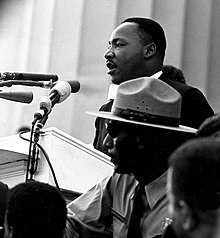
Although I'd heard snatches of Martin Luther's King's "I Have a Dream" speech, I'd never read it in its entirety before. Wow. What a writer...

"I have a dream that one day every valley shall be exalted, every hill and mountain shall be made low, the rough places will be made plain, and the crooked places will be made straight, and the glory of the Lord shall be revealed, and all flesh shall see it together.

This is our hope. This is the faith that I go back to the South with. With this faith we will be able to hew out of the mountain of despair a stone of hope. With this faith we will be able to transform the jangling discords of our nation into a beautiful symphony of brotherhood. With this faith we will be able to work together, to pray together, to struggle together, to go to jail together, to stand up for freedom together, knowing that we will be free one day."

-Martin Luther King Jr.

Find the whole speech HERE. Thanks to Gangrey for posting it.

-Steve